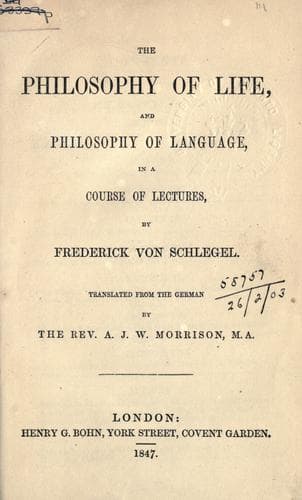
The philosophy of life, and philosophy of language, in a course of lecturesSchlegel, Friedrich von
Philosophy
The philosophy of life, and philosophy of language, in a course of lectures
Schlegel, Friedrich von
Language and languages -- Philosophy; Life; Philosophy
The philosophy of life can not be any mere science of reason, and least
of all an unconditional one. For such does but lead us into a domain of
dead abstractions alien to life, which, by the dialectical spirit of
disputation connatural to the reason, is soon converted into a
labyrinthine maze of contradictory opinions and notions, out of which
the reason, with all its logical means and appliances, can not extricate
itself. And life, consequently--the inner spiritual life, that is--is
disturbed and destroyed by it. And it is even this disturbing and
destroying principle of the dialectical reason that most requires to be
got rid of and brought into subjection. In the mere form, however, of
abstract thought there is nothing in and by itself opposed to the truth.
There is nothing in it that it is absolutely and invariably necessary to
avoid, or that never and in no case admits of application. It is, no
doubt, most certain that every system of philosophy is on a wrong track
which borrows its method exclusively from mathematics, and copies it
throughout from beginning to end. Still, in the progressive development
of philosophical ideas certain points may occur--there may be certain
places in the entire system--where occasionally and by the way such
formulas and abstract equations may be profitably employed. Such a case
may happen in the present Lecture. But by thus employing them only by
way of illustration, and episodically in passing, I hope to establish
such a use of them, and to make it evident that the perspicuity of the
exposition does not essentially suffer thereby.
Philosophy, as the universal science, embraces in its consideration the
whole man. As, therefore, it evidently involves the occasion, so it is
not unlikely that cases may occur where it can happily borrow, now from
one now from another of the sciences, its external form and peculiar
formularies. It can, in short, advantageously avail itself of all in
turn. Only, such a use, to be profitable, must be free. And this freedom
will best evince itself in the deliberate choice and the diversity of
the images. The method of free speculation, _i.e._, of philosophy, must
not resemble a coat of mail with its infinite number of little uniform
chains and rings. It ought not, as is the case nearly with the
mathematical method, to be composed, by mechanical rule and measure, of
simple propositions scientifically linked together, and then formed
again into higher logical concatenations. In short, the method of
philosophy can not properly be uniform. The spirit must not be made
subservient to the method; the essence must not be sacrificed to the
form.
Public-domain text, read in full here on John Shaqi.
Reviews
Reviews
No reviews yet
Be the first to share your thoughts on this work.
Elsewhere in the archive
Join the Discussion
Join the discussion
Sign in to leave a comment or review.
Sign InorCreate an account