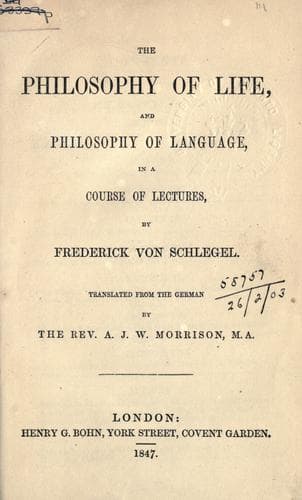
The philosophy of life, and philosophy of language, in a course of lecturesSchlegel, Friedrich von
Philosophy
The philosophy of life, and philosophy of language, in a course of lectures
Schlegel, Friedrich von
Language and languages -- Philosophy; Life; Philosophy
But still, all this is little more than a description of the whole idea
which I have allowed myself, merely with a view of employing it as a
passage to the point which is at present in question. That purpose was,
on the supposition of the existence of such superior beings, accurately
to indicate which of man’s powers, or faculties of mind and soul, may
rightly be attributed to them. Now, to my mind, the distinction is very
strikingly suggested in the well-known sentiment of one of our famous
poets. Thus he addresses man--“Thy knowledge thou sharest with superior
beings;” superior, for in the clearness of their eternal science they
undoubtedly stand far higher than men: and then he continues, “But art
thou hast alone.”[11] But, now, what else is art than fancy become
visible, and assuming a bodily shape, or word, or sound? It is,
therefore, this nimble-footed, many-shaped, ever-inventive fancy, which
forms the dangerous prerogative of man, and can not be ascribed to
these pure spiritual beings. And as little justifiable would it be to
ascribe to them that human reason, with its employment of means, and its
slow processes of deduction and comparison. Instead of this, they
possess the intuitive understanding, in which to see and to understand
are simultaneous and identical. If, then, in an accurate sense of the
terms, neither fancy nor reason belongs to them, it would further be
wrong to attribute them a soul as distinct from the mind or spirit, and
as being rather a passive faculty of inward productiveness, and change,
and internal growth. Briefly to recapitulate what has been said: The
existence of the brutes is simple, because in them the soul is
completely mixed up and merged in the organic body, and is one with it;
on the destruction of the latter it reverts to the elements, or is
absorbed in the general soul of nature. Twofold, however, is the nature
of created spirits, who besides this ethereal body of light are nothing
but mind or spirit; but threefold is the nature of man, as consisting of
spirit, soul, and body.[12] And this triple constitution and property,
this threefold life of man, is, indeed, not in itself that pre-eminence,
although it is closely connected with that superior excellence which
ennobles and distinguishes man from all other created beings. I allude
to that prerogative by which he alone of all created beings is invested
with the Divine image and likeness. This threefold principle is the
simple basis of all philosophy; and the philosophical system which is
constructed on such a foundation is the philosophy of life, which
therefore has even “words of life.” It is no idle speculation, and no
unintelligible hypothesis. It is not more difficult, and needs not to be
more obscure, than any other discourse on spiritual subjects; but it can
and may be as easy and as clear as the reading of a writing, the
observation of nature, and the study of history. For it is, in truth,
Public-domain text, read in full here on John Shaqi.
Reviews
Reviews
No reviews yet
Be the first to share your thoughts on this work.
Join the Discussion
Join the discussion
Sign in to leave a comment or review.
Sign InorCreate an account