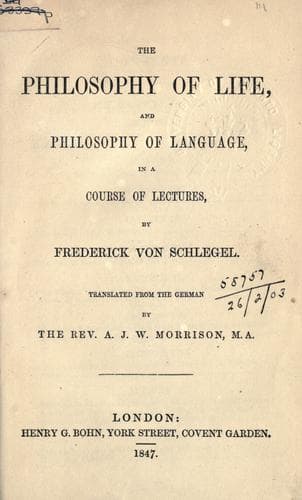
The philosophy of life, and philosophy of language, in a course of lecturesSchlegel, Friedrich von
Philosophy
The philosophy of life, and philosophy of language, in a course of lectures
Schlegel, Friedrich von
Language and languages -- Philosophy; Life; Philosophy
nothing else than a simple theory of spiritual life, drawn from life
itself, and the simple understanding thereof. If, however, it becomes
abstract and unintelligible, this is invariably a consequence, and, for
the most part, an infallible proof of its having fallen into error. When
in thought we place before us the whole composite human individual,
then, after spirit and soul, the organic body is the third constituent,
or the third element out of which, in combination with the other two,
the whole man consists and is compounded. But the structure of the
organic body, its powers and laws, must be left to physical science to
investigate. Philosophy is the science of consciousness alone. It has,
therefore, primarily to occupy itself with soul and spirit, or mind, and
must carefully guard against transgressing its limits in any respect.
But the third constituent beside mind and soul, in which these two
jointly carry on their operations, needs not always, as indeed the above
instance proves, to be an organic body. In other relations of life, this
third, in which both are united, or which they in unison produce, may be
the word, the deed, life itself, or the divine order on which both are
dependent. These, then, are the subjects which I have proposed for
consideration. But in order to complete this scale of life, I will
further observe--triple is the nature of man, but fourfold is the human
consciousness. For the spirit or mind, like the soul, divides and falls
asunder; or, rather, is split and divided into two powers, or
halves--the mind, namely, into understanding and will, the soul into
reason and fancy. These are the four extreme points, or, if the
expression be preferred, the four quarters of the inner world of
consciousness. All other faculties of the soul, or powers of mind, are
merely subordinate ramifications of the four principal branches; but the
living center of the whole is the thinking soul.
LECTURE II.
OF THE LOVING SOUL AS THE CENTER OF THE MORAL LIFE; AND OF MARRIAGE.
Public-domain text, read in full here on John Shaqi.
Reviews
Reviews
No reviews yet
Be the first to share your thoughts on this work.
Join the Discussion
Join the discussion
Sign in to leave a comment or review.
Sign InorCreate an account