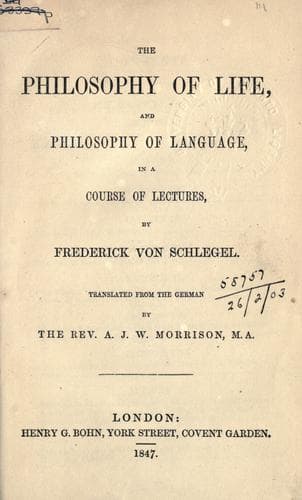
The philosophy of life, and philosophy of language, in a course of lecturesSchlegel, Friedrich von
Philosophy
The philosophy of life, and philosophy of language, in a course of lectures
Schlegel, Friedrich von
Language and languages -- Philosophy; Life; Philosophy
No doubt the heathenism of the first races, so far as we can trace it,
and the early legends and rites of the oldest times that we are
acquainted with, appear to be already involved in a perplexing confusion
of the strangest fancies. Nothing better are they than a chaos of
symbolical images of nature, mingled and interwoven with some vague and
shadowy outlines of truly spiritual ideas and thoughtful notes of a
higher strain, and also with ambiguous and enigmatical legends of
historical tradition. The whole medley, moreover, differently developed,
according to the peculiar varieties of national character, or the
hereditary feeling of tribe and family, assumes a particular hue from
the local colorings of these different spheres of life; or, moreover, as
is not unfrequently the case, is remolded and cast into new combinations
by the arbitrary caprices of the poetic fancy. Who can hope to find the
simple clew of such a maze? or who will give us the threads of Ariadne
to guide us out of its intricacies?
It is true, generally speaking, that our historical knowledge and
research do not reach very far back. The Flood, to which the traditions
of all people remount, and which all telluric sciences, whether
geography, or natural history, or geology, or whatever other name they
may bear, directly or indirectly confirm, forms an impassable gulf
between the modern and later family of man, and that first and gigantic
race of the antediluvian world. And yet careful criticism and historical
investigation are still able to distinguish in the chaotic congeries of
different mythologies the several strata and epochs, and can separate
the primary rock of the earlier natural legend from the later mythical
formations. But even this primary rock itself, amid the legends of
primeval times--this first, and oldest, and simplest basis of
heathenism, is itself but a fusion and the _debris_ of some earlier and
precedent convulsion. But now all legends, every mythology, and
universal tradition, agree in this one point. They concur in deriving
the origin of man from God, and assert that the first man, who, while he
proceeded immediately from God, was also the first-born son of earth,
in which he was placed, because it was of a nature nearest akin to his
and ours. Now this same first man, as proceeding and taking his
beginning from God, could not well be without some knowledge of Him. The
concurrent tradition of all nations leads us to the idea of man’s
possessing knowledge, and in truth an immediate and intuitive knowledge
of God in and out of nature, and indeed primarily and principally from
this source, and on the other hand also of his having an immediate and
intuitive knowledge of nature in God. And this exactly is the old and
true Gentilism of the holy patriarchs of the primeval world, if by this
term we understand the original religion of nature, among the earliest
families, and the pious patriarchs of the human race, as it is described
Public-domain text, read in full here on John Shaqi.
Reviews
Reviews
No reviews yet
Be the first to share your thoughts on this work.
Elsewhere in the archive
Join the Discussion
Join the discussion
Sign in to leave a comment or review.
Sign InorCreate an account