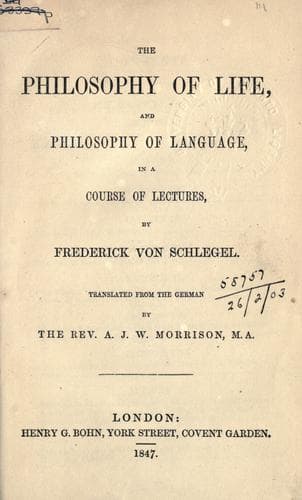
The philosophy of life, and philosophy of language, in a course of lecturesSchlegel, Friedrich von
Philosophy
The philosophy of life, and philosophy of language, in a course of lectures
Schlegel, Friedrich von
Language and languages -- Philosophy; Life; Philosophy
in the language and after the analogy of Holy Writ,[51] and also in the
ancient traditions which have grown out of and attached themselves to
it. Now, according to the simple progression of truth, which is also
that of God, and of the knowledge of Him, this revelation of nature was
the first and earliest that was imparted to man upon earth, and must be
carefully distinguished from that later or second revelation of God,
which is both of a positive nature and is contained in a written law, or
written word and book of the law. And in the written revelation this
distinction is most carefully observed throughout. The divine law, which
although not written on brazen tablets, unquestionably existed in these
primeval ages of a natural revelation, which was read and intuitively
understood in nature herself, or immediately in the hearts and minds of
men, was far simpler, and consequently also easier and less burdensome,
than the later law of the second revelation, which was designed for the
moral regeneration of a degenerate people, and for fitting them to be a
witness of the truth to other nations of the world still more degraded
and benighted than themselves. And in the same way this second
revelation was less stringent and less exalted in its scope than the
last law of later times, promulgated in the third age of the world to
all nations and kindreds of the earth. For the latter was not designed
for the first happy period of the infancy of mankind, but for his last
difficult, but decisive struggle, which is to end in the perfect
triumph of good, and in man’s total emancipation from the hostile and
oppressive yoke of original evil. For the wise and omniscient Father of
all has given to every age of man’s history a peculiar and appropriate
law. For the infancy of the race, He published an easy rule of
life--permitting the full expansion and the blooming development of all
his vital energies; but one of sterner preparation, of promise and of
expectation, for his youth. For his maturity, lastly, He has set forth a
law of determined struggle with evil, and of a predominant love of the
invisible, and even of perfection. And consequently a new application of
the same law, and a new strengthening for the same conflict, is to be
looked for in the last times of the final consummation. But not only was
the divine natural law, as promulgated to man in the earliest ages, far
different from that of later times, and the subsequent stages of a
further development of revealed knowledge. This immediate revelation,
and intuitive knowledge of nature, was likewise very dissimilar to the
artificially elaborate and complicated systems of physical science. For
these have principally to trace out and to revert to the original source
of life, and of the full truth of nature, although even on this right
road of return we are not always nearest to the end, even when we seem
to have made the greatest advance in that direction. But as the first
Public-domain text, read in full here on John Shaqi.
Reviews
Reviews
No reviews yet
Be the first to share your thoughts on this work.
Elsewhere in the archive
Join the Discussion
Join the discussion
Sign in to leave a comment or review.
Sign InorCreate an account