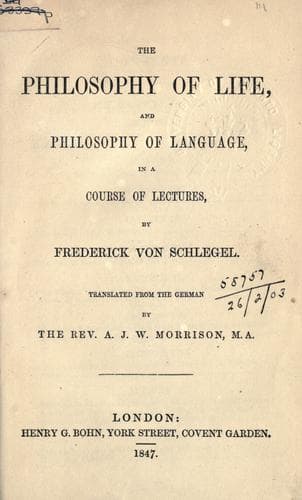
The philosophy of life, and philosophy of language, in a course of lecturesSchlegel, Friedrich von
Philosophy
The philosophy of life, and philosophy of language, in a course of lectures
Schlegel, Friedrich von
Language and languages -- Philosophy; Life; Philosophy
man recognized God in nature, and not merely understood, but immediately
perceived, and, as it were, saw, that He was there, therefore nature
also was, in a certain measure, transparent to his eye in God. And
although his knowledge of nature was in the highest degree simple, still
did it even on that account penetrate more deeply into its inmost
secrets. It was rendered thereby more thoroughly vital and endued with
power. One might almost call it a natural force within him, similar to
and akin to those without him. For generally in those early ages of the
world, man possessed many higher energies and living powers in and over
nature, which subsequently were entirely withdrawn from him, or which in
later times, as wonderful phenomena, formed singular exceptions to man’s
ordinary endowments.
We are, perhaps, only too much disposed to imagine that the ancient race
before the Flood resembled in every particular a later and even the
present generation. Our conceptions of it, as regards both its virtues
and its vices, are in nowise great and wonderful enough. In the first
place, it is highly probable that the atmosphere of the globe was at
that period totally different from what it is in the present day, and
that consequently both the food and manner of living in those days were
also dissimilar from our own. If any reliance is to be placed on the
best and oldest historical testimonies on these points, we can scarcely
doubt that the primeval race--at least the generations immediately
preceding the Deluge--were of gigantic stature, and that their mental
powers and faculties were on a correspondent scale of magnitude. In
perfect conformity with these other proportions, the Scripture also
assigns to those antediluvian races a duration of existence, which, as
compared with our own standard of the average life of man, is equally
gigantic. And so little of antecedent improbability is there in this
statement, that to get rid of it commentators have been forced to have
recourse to the most far-fetched and arbitrary, and, in fact, most
untenable and groundless hypotheses.
Public-domain text, read in full here on John Shaqi.
Reviews
Reviews
No reviews yet
Be the first to share your thoughts on this work.
Elsewhere in the archive
Join the Discussion
Join the discussion
Sign in to leave a comment or review.
Sign InorCreate an account