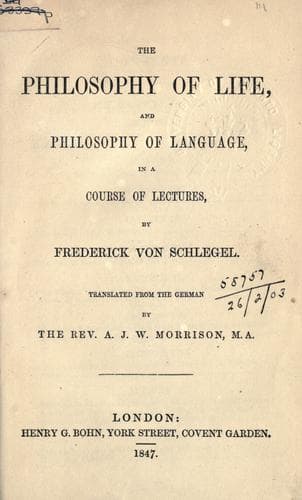
The philosophy of life, and philosophy of language, in a course of lecturesSchlegel, Friedrich von
Philosophy
The philosophy of life, and philosophy of language, in a course of lectures
Schlegel, Friedrich von
Language and languages -- Philosophy; Life; Philosophy
In truth, the imitation of actual reality, however difficult and in
itself worthy of admiration it may be, does not constitute the aim or
object, or generally the principle of sculpture, any more than of any
other art. A remarkable proof of this is afforded by the fact that
color, with all its charms, is excluded from the plastic art and its
embodied manifestations as too meretricious and too closely allied to
reality. For by such an expedient, not less than by the use of ingenious
mechanism to give motion to the limbs, the artistic ideal, or the images
of the gods, would have degenerated into the puppets of children.
Reality, therefore, with its actual shapes and the delusive imitation
and servile copying of them, is in nowise the proper or immediate object
of the plastic art. Even beauty of form is not always, not at least
solely and exclusively its aim; it is only so accidentally and
relatively, as a condition of the expression of character, of external
states, and of the total significance. Always and universally it is a
thought, the _idea_ of some subject or form as the inner sense and
significance thereof, that constitutes the essence of a work of art, and
with which art in general is concerned. In other words, art is
symbolical. And this may be predicated with equal truth of every higher
art, as well as of sculpture, whatever may be the medium of its
manifestations, whether a statue, or tone as in music, or words as in
poetry. It is exactly this that constitutes the difference between high
art and every other which, however closely allied to it in appearance,
has some ulterior and practical object, and which therefore can not be
symbolical.
Of this kind, for instance, is the difference between rhetoric (which
most assuredly is an art, or at least was exclusively treated as such by
the Greeks) and poetry. And it is of the utmost importance to keep this
distinction constantly in view. For exactly in the same degree that it
is neglected is the proper character and true excellency of the higher
art of the beautiful lost sight of. And a right estimate of the other
arts which have an ulterior and practical object would also be
endangered. An orator who with the greatest command of practical and
imaginative language is nevertheless devoid of convincing logical power
to sway the minds of men by his arguments, and to bend them irresistibly
to his purpose, would exercise but little influence; while no heavier
censure can be passed on one who sets up for a poet, than to affirm of
him, that he possesses and understands nothing but the rhetoric of
passion, without--though such further qualification is evidently
superfluous--true poetry.
Public-domain text, read in full here on John Shaqi.
Reviews
Reviews
No reviews yet
Be the first to share your thoughts on this work.
Elsewhere in the archive
Join the Discussion
Join the discussion
Sign in to leave a comment or review.
Sign InorCreate an account