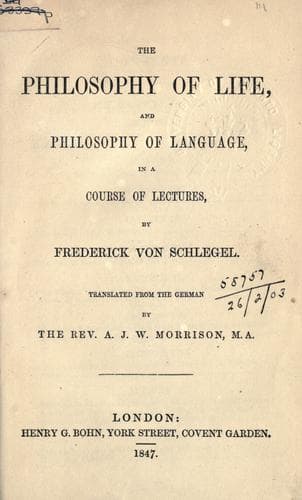
The philosophy of life, and philosophy of language, in a course of lecturesSchlegel, Friedrich von
Philosophy
The philosophy of life, and philosophy of language, in a course of lectures
Schlegel, Friedrich von
Language and languages -- Philosophy; Life; Philosophy
If, now, all the natural wants and properties of man are symbolical--if
such be his present state in the midst of creation--his whole position
in the mundane system, and his high and heavenly destination, can we,
or, rather, ought we, to wonder if even religion presents itself for the
most part clothed in a symbolical garb? For this is the case, not merely
with that which was the wild upgrowth of a poetical and purely
imaginative heathenism, but also the old, original, and pure religion of
nature--as the first love devoting itself for sacrifice--the second
revelation of God. And so we find it to have been in the old world, or,
as it is otherwise called, the old covenant. Here the first twilight of
faith was yet studded with all the starry splendor of the whole
symbolical creation, as it were with the brilliant diadem of nature’s
most glorious images. And even the new era of the ascending and
brightening dawn still bears on its front the glittering morning-star of
art.
But now, if still retaining the same figure, or, rather, borrowing from
it a contrast, we proceed to designate art in and by itself, we may
justly compare it to the moon, which illumines with its vague but
marvelous _half-light_ the domain of night and the dark realms of
creative fancy. Even here it is but a borrowed splendor from the true
sun, a reflection from another and a higher luminary, that lights up the
darkness. And while all the wonderful starry types of the spiritual
world, which retire in the full day, come out in this magical twilight,
so also deceptive phantoms, airy forms of gigantic magnitude, may mingle
with the hovering and misty troop of shadows to which the earth-born
vapors alone give birth and shape. And yet, notwithstanding this earthly
intermixture, the art of the beautiful, whenever it retains its true
nature, is in its essence directed to the divine. Consequently it not
only lends an external charm to religion, but in its origin, in all
times and peoples, it was intimately related to it, and bound to it by
the strictest ties of affinity and association. And this is not the less
true, even though to the eye of a severe criticism most of its
productions, in the ages of its decline, may appear utterly remote from
its first source and aim, and perfectly vain, worthless, and sensual.
Public-domain text, read in full here on John Shaqi.
Reviews
Reviews
No reviews yet
Be the first to share your thoughts on this work.
Elsewhere in the archive
Join the Discussion
Join the discussion
Sign in to leave a comment or review.
Sign InorCreate an account