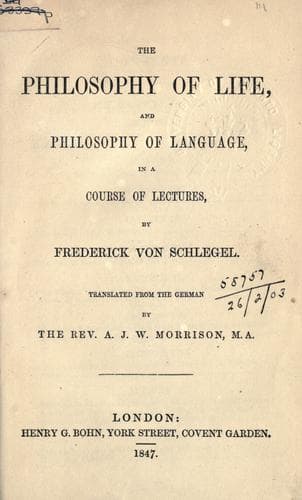
The philosophy of life, and philosophy of language, in a course of lecturesSchlegel, Friedrich von
Philosophy
The philosophy of life, and philosophy of language, in a course of lectures
Schlegel, Friedrich von
Language and languages -- Philosophy; Life; Philosophy
The divine origin of art is easily proved by its history every where,
and indeed is so manifest that it can not well be doubted. High art,
indeed, can not and never will surrender its claim to a divine power and
sanctity: it must insist upon the recognition of this its high sanction.
If we could conceive an age or country where religion should entirely
cease and be forgotten--where not only all positive faith and
revelation, but even the universal belief in a Divinity above them,
should die away and perish among men--the light of all higher and
heaven-directed thoughts and aims should become extinct--that echo of
eternity and of eternal love which the inmost feelings of the human soul
spontaneously gives back, should be hushed forever--then and there at
the self-same moment would all high art be withdrawn and disappear.
In our own age the state of things is the direct contrary to that which
we have been supposing. While from the universal prevalence of
freethinking in politics--a natural consequence of the reign of
religious skepticism--the whole of life, and especially public life, has
ceased to be regarded and understood in its symbolical character and
dignity; while the little of religious sentiment that still survives is
more or less distracted and secularized by sectarian controversy, and
scarcely one inviolable sanctuary is left for a simple and undoubting
faith to shelter in--art and the beautiful are for a certain portion of
the educated classes the only fresh oasis of divinity amid the
surrounding desert of worldliness. It is the last treasure left to them,
and, indeed, prized by them as such, and regarded as the true palladium
of a higher intrinsic life; but this, in its isolated state and by
itself, it never can be.
In this respect the present age may be likened to a noble house, fallen
from its primitive wealth and magnificence into decay and ruin. Its
revenues dissipated by misfortunes, mismanagement and extravagance; its
mansion and domains mortgaged or encumbered with debt, nothing remains
to it but the family jewels. These time-honored heirlooms of better days
are all that it still retains of its former opulence. And even in these
many a false stone has been introduced among the old genuine diamonds;
much spurious metal has been substituted for the sterling gold of
antiquity. Apparently, however, the whole are still preserved as the
last relic of a former splendor, and of a wealth which once seemed
inexhaustible. In the same way the present generation supports its inner
and higher life on the mere external treasures of art, while the great
capital of ancient faith, to which among other excellent fruits that
ornament of beauty owed its existence, has by the great majority been
long squandered on the “_spirit of the age_.”
Public-domain text, read in full here on John Shaqi.
Reviews
Reviews
No reviews yet
Be the first to share your thoughts on this work.
Elsewhere in the archive
Join the Discussion
Join the discussion
Sign in to leave a comment or review.
Sign InorCreate an account