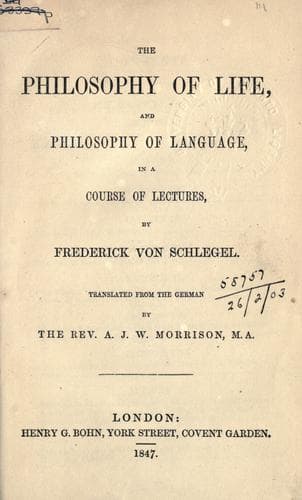
The philosophy of life, and philosophy of language, in a course of lecturesSchlegel, Friedrich von
Philosophy
The philosophy of life, and philosophy of language, in a course of lectures
Schlegel, Friedrich von
Language and languages -- Philosophy; Life; Philosophy
Strict impartiality, for instance, is a primary requisition in the
judge, but is it possible, nay, would it properly be just, to require
this in every case of a father? The judicial character, however, is the
predominant element of political government, and the supreme judicial
function is its essential aspect, with which all the other distinctive
characteristics or exclusive prerogatives of sovereign power are most
intimately connected. And on this account, while the paternal authority
rests primarily on that tie of souls which consists in the reciprocal
affection of parents and children, and while the priestly power is
limited to the sacerdotal and spiritual domain, the supreme judicial and
sovereign power in the state, which is responsible to God alone, as the
highest and paramount of these three sacred and venerated powers,
embraces the complete whole, if I may so say, the bodily reality of
man’s public life. And in this sphere of historical reality it will be
my endeavor to trace the further development of these three ideas as
they manifest themselves in the busy conflict of life and the age. And
to this subject I propose to devote the three following Lectures.
In concluding our present disquisition I will only add one remark. All
these three powers, as founded on nature, on divine revelation, and on
historical rights, are alike holy and sacred. The good, that is to say,
the prudent and affectionate father, the pious priest, and the righteous
king, are each and all, though in different ways and degrees, and with
different powers and rights, visible and acting vicegerents on earth of
the invisible God. The last, in truth, is not merely the representative
but the unlimited dispenser of divine justice. And this divine
foundation of these powers, which claim and present an inviolable
character of sanctity, forms the practical part of that symbolical
signification of life which in its highest phase has formed the theme of
the present Lecture.
LECTURE XIII.
OF THE SPIRIT OF TRUTH AND LIFE IN ITS APPLICATION TO POLITICS, OR OF
THE CHRISTIAN CONSTITUTION OF THE STATE AND THE CHRISTIAN IDEA OF
JURISPRUDENCE.
Public-domain text, read in full here on John Shaqi.
Reviews
Reviews
No reviews yet
Be the first to share your thoughts on this work.
Elsewhere in the archive
Join the Discussion
Join the discussion
Sign in to leave a comment or review.
Sign InorCreate an account