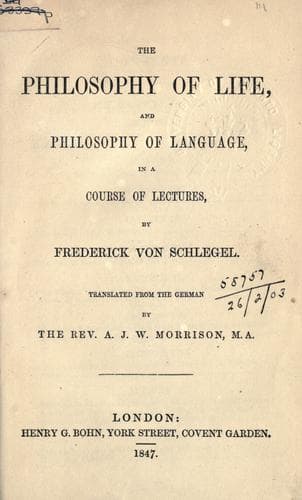
The philosophy of life, and philosophy of language, in a course of lecturesSchlegel, Friedrich von
Philosophy
The philosophy of life, and philosophy of language, in a course of lectures
Schlegel, Friedrich von
Language and languages -- Philosophy; Life; Philosophy
I am alluding to the ancient German, or the Christian Roman Empire of
the middle ages, during a period of many centuries, and in the time of
its vigor and splendor, when it led, not to say, formed, the great
political world.[57] As an elective empire, but still monarchical in the
unity of the whole, it possessed so far a republican tendency and shape.
And this it preserved even long afterward, when, by a long succession
of emperors of the same house, the imperial crown had in fact become
almost the hereditary right of a single family; for the solemn sanction
of an election was still indispensable, and this gave rise to more than
one exception or interruption to the otherwise historically confirmed
law of succession. Moreover, this great system or confederation of
states embraced many smaller and principally republican states; at least
in its members were comprised every possible form of political
constitution. The four great dukedoms, who in the imperial diet were the
original representatives, together with the other hereditary powers
which subsequently attained to the electoral dignity, formed, as it
were, the monarchical element in the whole body, retaining, however, at
the same time, its national and popular character. Alongside of these
the spiritual princes, as entirely dependent on choice and election for
their dignities, formed an aristocracy, not only of birth, but of
science and the intellectual culture of the age--in short, an
aristocracy of merit. Lastly, the trading and manufacturing free towns,
with their imperial privileges and charters, formed, among the other
members of the Empire, a true democratical element, in the highest and
noblest sense of the term. For we must not understand thereby any mere
universal equality, leading to the usual popular anarchy, but
corporations, with well-defined rights, of the burgher classes, as they
attained to historical importance and influence. The very name of the
Hanse Towns is sufficient to remind us of the vast and important part
which the latter played, even in the declining times of the Empire.
Public-domain text, read in full here on John Shaqi.
Reviews
Reviews
No reviews yet
Be the first to share your thoughts on this work.
Elsewhere in the archive
Join the Discussion
Join the discussion
Sign in to leave a comment or review.
Sign InorCreate an account