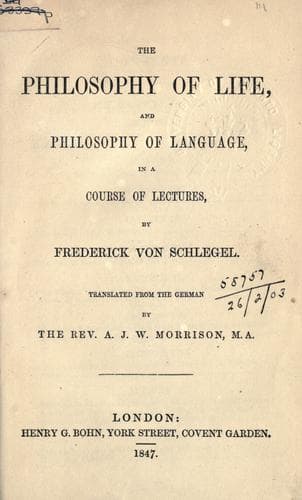
The philosophy of life, and philosophy of language, in a course of lecturesSchlegel, Friedrich von
Philosophy
The philosophy of life, and philosophy of language, in a course of lectures
Schlegel, Friedrich von
Language and languages -- Philosophy; Life; Philosophy
Thus free and republican in its spirit was the old Christian monarchy of
the German Kaisers. It had no doubt to undergo many convulsions from
domestic faction, and, finally sunk beneath them. Still this political
constitution of the middle ages, in their best days, must forever remain
a remarkable and singular phenomenon. Its full and deep significance and
grandeur are little recognized, and still less perfectly understood, by
the modern science of politics. Peculiarly Christian in principle, in
its kingly administration as vigorous and successful as any other state
in the most brilliant eras of the history of the world, while in the
internal development of its republican members and constituents it was
more rich and varied, and, in truth, much freer than even the most
lauded among the mixed constitutions of modern times. For historical
experience, that great teacher of political science, distinctly proves
that in those _dynamical_ states, which are based on the principle of
the division and nicely-adjusted balance of power, the ministry and the
opposition usurp between them all the functions of authority, while the
sacred cipher of an hereditary monarch is nothing more than a mere
shadow, beneath which they can sit at ease to carry on their endless
disputes.
The Christian view, then, of the world, and of the state, as we have
already remarked, does not exclude or reject any form of political
existence. On the contrary, it recognizes whatever possesses an
historical cause and foundation, and allows it to stand in its proper
place, and in its true and original significance and rights.
Accordingly, it admits the validity as such even of the dynamical form
of polity, even though it feels it impossible to agree with partial and
enthusiastic admirers in considering it as perfect. Nay, it does not
reject even an absolute despotism, notwithstanding that it sees clearly
enough all its imperfections and great inferiority. It is only by a
complete view of history that their existence can be explained and
understood. And in this they will appear either as a necessary evil in
its mildest form, _i.e._, as the less pernicious and dangerous, under
existing circumstances, or as a remedy for some more fearful disorder,
by which alone the social frame can be restored to a more healthy
condition.
Public-domain text, read in full here on John Shaqi.
Reviews
Reviews
No reviews yet
Be the first to share your thoughts on this work.
Elsewhere in the archive
Join the Discussion
Join the discussion
Sign in to leave a comment or review.
Sign InorCreate an account