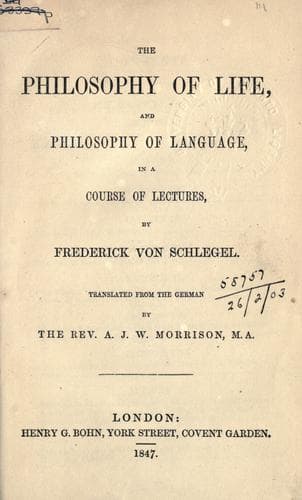
The philosophy of life, and philosophy of language, in a course of lecturesSchlegel, Friedrich von
Philosophy
The philosophy of life, and philosophy of language, in a course of lectures
Schlegel, Friedrich von
Language and languages -- Philosophy; Life; Philosophy
Consistently, then, with this notion of philosophy, and under this
limitation, I have not, I think, deviated in the latter Lectures from
the law I originally laid down. Inasmuch, however, as the exposition of
a philosophy of life must necessarily be _vivid_, and consequently
requires to be interspersed with historical views and examples, I must
request you, looking principally to the ideas which form the essential
foundation of these discourses, to judge the latter by the pervading
tenor and connection of the thoughts rather than by the several
allusions and instances which I have introduced for the mere purpose of
illustration. All that is merely personal in the interpretation passed
upon those events will, I trust, be looked upon as the private opinions,
indeed, but still the unprejudiced conclusions, of an individual.
In the course of these Lectures I attempted, first of all, to establish
a firm foundation for the human soul, considered both in its own proper
nature and with regard to its most essential relations in life to nature
and to God. In the next place, by investigating the order of the divine
dispensations in nature, and in the realms of truth and history, it was
my endeavor to obtain for it a wider and more solid basis. Lastly, I
occupied myself with tracing the course which the Spirit of Eternal
Truth pursues in science and in life, and the shapes which in its
progress toward perfection it successively assumes. Accordingly, I have
pointed out to you, first of all, how this Spirit of Eternal Truth is
ever one and the same in the highest science and in divine faith; then,
how victoriously it comes forth out of the conflict between faith and
infidelity; and, in conclusion, I showed you that, far from being
confined to the narrow region of science, it may and rightly ought to
enter with an earnest influence into life itself. How the latter duty is
actually fulfilled we endeavored to show, by considering the symbolical
signification of life, and, as derived therefrom, its higher sanction
and divine foundation, especially in public life and the state. And
herein the idea of a universal Christian and truly historical justice
found a closer application and wider development. And this formed the
subject of our last disquisition.
Public-domain text, read in full here on John Shaqi.
Reviews
Reviews
No reviews yet
Be the first to share your thoughts on this work.
Elsewhere in the archive
Join the Discussion
Join the discussion
Sign in to leave a comment or review.
Sign InorCreate an account