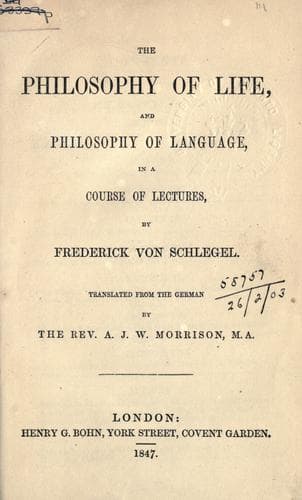
The philosophy of life, and philosophy of language, in a course of lecturesSchlegel, Friedrich von
Philosophy
The philosophy of life, and philosophy of language, in a course of lectures
Schlegel, Friedrich von
Language and languages -- Philosophy; Life; Philosophy
I there sought to elucidate this idea solely and entirely from history.
For this purpose I endeavored, by means of historical instances, to set
in a clear, discriminating light the opposite and divergent notions of
an absolute and of a dynamical or limited monarchy, so far at least as
regards the essential features and characteristic constitution of each.
As instances of the former, I pointed to the old Roman world and the
empire of the caliphs, while the latter was elucidated by the English
constitution, in which, as yet, it has attained to its highest and most
perfect development. This is, no doubt, a master-piece of political
wisdom, wherein an intractable spirit of opposition being adopted, as it
were, into the very constitution, is thereby rendered legitimate and its
evil tendency is held in check. Still the principle of it can not
rightly be viewed in any other light than the wise procedure of the
physician who, in the case of an inevitable epidemic, resolves to
inoculate the disease in order to be able to control it the better, and
by watching more closely its crisis, to regulate its course and issue.
In its true historical place, therefore, this constitution finds its
satisfactory explanation and justification; or, rather, deserves our
highest praise, the fullest acknowledgment of its merits, and even our
admiration. But inasmuch as every feature of it is thoroughly historical
and national, and since the slightest local diversity in the character
of a people or nation might with different relations and circumstances
give rise to wants and difficulties little expected or dreamed of, we
must be cautious how we seek to introduce it elsewhere. In the arts it
is ever a sorry business to imitate great works of original genius. By
such a course little but _manner_ is multiplied. So it is rarely a
felicitous idea to suppose that a constitution, though copied from ever
so lauded a model, must be suited to all nations alike, and must prove a
universal and unfailing source of political felicity--a tree of liberty,
which we may transplant at pleasure, or, as it were, a constitutional
bill of exchange, which, once endorsed we may put in circulation.
Public-domain text, read in full here on John Shaqi.
Reviews
Reviews
No reviews yet
Be the first to share your thoughts on this work.
Elsewhere in the archive
Join the Discussion
Join the discussion
Sign in to leave a comment or review.
Sign InorCreate an account