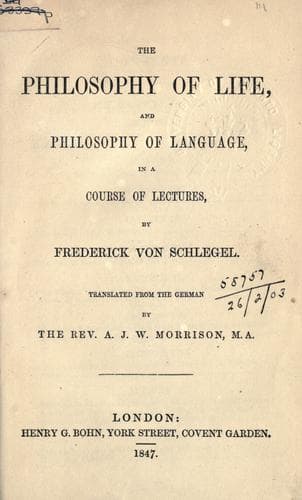
The philosophy of life, and philosophy of language, in a course of lecturesSchlegel, Friedrich von
Philosophy
The philosophy of life, and philosophy of language, in a course of lectures
Schlegel, Friedrich von
Language and languages -- Philosophy; Life; Philosophy
“There are,” says a poet as ingenious as profound,[1] “more things in
heaven and earth than are dreamt of in our philosophy.” This sentiment,
which Genius accidentally let drop, is in the main applicable also to
the philosophy of our own day; and, with a slight modification, I shall
be ready to adopt it as my own. The only change that is requisite to
make it available for my purpose would be the addition--“and also
between heaven and earth are there many things which are not dreamt of
in our philosophy.” And exactly because philosophy, for the most part,
does nothing but dream--scientifically dream, it may be--therefore is it
ignorant, ay, has no inkling even of much which, nevertheless, in all
propriety it ought to know. It loses sight of its true object, it quits
the firm ground where, standing secure, it might pursue its own
avocations without let or hinderance, whenever, abandoning its own
proper region, it either soars up to heaven to weave there its fine-spun
webs of dialectics, and to build its metaphysical castles in the air, or
else, losing itself on the earth, it violently interferes with external
reality, and determines to shape the world according to its own fancy,
and to reform it at will. Half way between these two devious courses
lies the true road; and the proper region of philosophy is even that
spiritual inner life between heaven and earth.
On both sides, many and manifold errors were committed even in the
earlier and better days of enlightened antiquity. Plato himself, the
greatest of the great thinkers of Greece, set up in his Republic the
model of an ideal polity, which, in this respect, can not bear the test
of examination. His design indeed finds, in some measure, its apology in
the disorders and corruption which, even in his day, had infected all
the free states of Greece, whether great or small. His work, too, by the
highly-finished style of the whole, the vivid perspicuity of its
narrative, its rich profusion of pregnant ideas and noble sentiments,
stands out in dignified contrast to the crude and ill-digested schemes
of legislation so hastily propounded in our own day. Still, it will ever
remain the weak point of this great man. One needs not to be a Plato to
see how absolutely unfeasible, not to say practically absurd, are many
of the propositions of this Platonic ideal. Accordingly, it has ever
been the fruitful occasion, not only among cotemporaries, but also with
posterity, of ridicule to the ignorant and of censure to the wise. In
this respect it can not but excite our regret that such great and noble
powers of mind should have been wasted in following a false direction,
and in pursuit of an unattainable end. The oldest philosophers of
Greece, on the other hand--those first bold adventurers on the wide
ocean of thought--combined together the elements of things, water, or
air, or fire, or atoms, or, lastly, the all-ruling intellect[2] itself,
into as many different systems of the universe.
Public-domain text, read in full here on John Shaqi.
Reviews
Reviews
No reviews yet
Be the first to share your thoughts on this work.
Join the Discussion
Join the discussion
Sign in to leave a comment or review.
Sign InorCreate an account