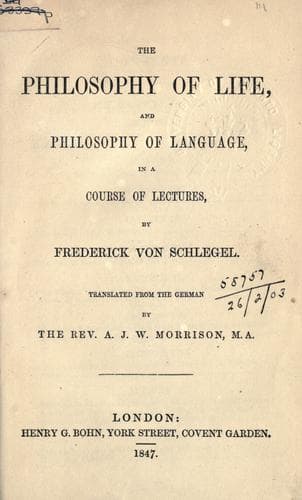
The philosophy of life, and philosophy of language, in a course of lecturesSchlegel, Friedrich von
Philosophy
The philosophy of life, and philosophy of language, in a course of lectures
Schlegel, Friedrich von
Language and languages -- Philosophy; Life; Philosophy
If, however, each in his
own way thus set forth a peculiar creed of nature, we must ever bear in
mind that the popular religion, with its poetical imagery, and the
fabulous mythology of antiquity, as affording not only no sufficient,
but absolutely no answer to the inquiring mind, as to the essence of
things, and the first cause of all, could not possibly satisfy these
earlier thinkers. Consequently, they might well feel tempted to find,
each for himself, a way to honor nature, and to contemplate the supreme
Being. Since then, however, the world has grown older by nearly
twenty-five centuries, and much, in the mean while, has been
accomplished by, or fallen to the share of, the human race. But when
philosophy would pretend to regard this long succession of ages, and all
its fruits, as suddenly erased from the records of existence, and for
the sake of change would start afresh, so perilous an experiment can
scarcely lead to any good result, but in all probability, and to judge
from past experience, will only give rise to numberless and interminable
disputes. Such an open space in thought--cleared from all the traces of
an earlier existence (a smoothly-polished marble tablet, as it were,
like the _tabula rasa_ of a recent ephemeral philosophy)--would only
serve as an arena for the useless though daring ventures of unprofitable
speculation, and could never form a safe basis for solid thought, or for
any permanent manifestation of intellectual life.
In itself it is nothing surprising if young and inexperienced minds,
occupying themselves prematurely, or in a perverted sense, with the
grand ideas of God and Nature, liberty and the march of thought, should
be wholly overmastered and carried away with them. It has often happened
before now, and it is no new thing if youthful and ardent temperaments
should either yield to the seductive temptation to make, not to say
create, a new religion of their own; or else feel a deceitful impulse to
censure and to change all that is already in existence, and, if
possible, to reform the whole world by their newly-acquired ideas.
Public-domain text, read in full here on John Shaqi.
Reviews
Reviews
No reviews yet
Be the first to share your thoughts on this work.
Join the Discussion
Join the discussion
Sign in to leave a comment or review.
Sign InorCreate an account