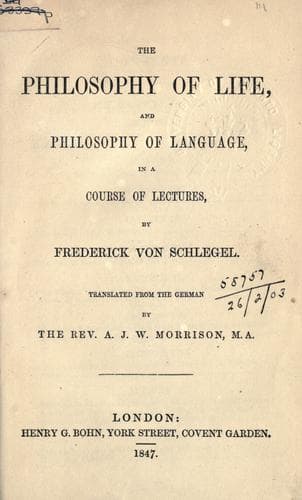
The philosophy of life, and philosophy of language, in a course of lecturesSchlegel, Friedrich von
Philosophy
The philosophy of life, and philosophy of language, in a course of lectures
Schlegel, Friedrich von
Language and languages -- Philosophy; Life; Philosophy
But let us turn our eyes from the insignificant controversies, with its
host of ephemeral publications, the interest of which seems little
likely to outlive even that of a daily journal, and let us look to the
greater and more historical phenomena amid them, which, in all
probability, will mark an epoch in the development of mind. From these
it is distinctly apparent that science is a real and actual power. In
proof of this fact, we need only appeal to the great talents and
abilities which, not only in recent years, but also throughout the last
century, have exercised in the domain of science what, without
exaggeration, we may well term a world-embracing influence. Only we must
admit that in this period they have taken more or less a destructive
tendency, and one that threatened in this scientific burrowing to
undermine the foundations of everlasting truth. But if we will take a
still wider survey, so as to embrace all the several periods of the
world’s history, and the course of the human mind therein, then,
undoubtedly, we may discern the higher might of divine truth,
manifesting itself as an influence for good, as a pure and genuine
spiritual theocracy of science, to whose domain above all others the
idea of an immediate and higher supremacy of mind and divine power is
peculiarly applicable.
LECTURE XV.
OF THE TRUE IDEA OF A THEOCRACY; OF THE MIGHT OF SCIENCE, AND OF THE
FINAL RESTORATION AND PERFECTION OF THE HUMAN CONSCIOUSNESS.
The idea which the adverse party, or opposition, in the political
domain, and in the scientific theory of politics, usually form of a
theocracy, is for the most part incorrect. By the adverse party I mean
all those who either openly assail, or privately call in question, the
religious foundation, the higher sanction, and the divine authority of
the state; in short, those in general who are hostile to the religious
sentiment. The latter apply the idea of theocracy and employ the term to
signify the rule of the spiritual power, such as the Egyptian priesthood
may, perhaps, or, at least, such as they suppose them to have
possessed--or a polity where the supreme temporal authority works in
unison with the sacerdotal class.
And even by the defenders of the good cause--by men of higher and better
principles, the idea is frequently taken in too inaccurate and
indefinite, not to say incorrect, a sense. They seem to understand by it
nothing more than the divine authority of the state and of the Church,
and their mutual support and dependence, and their co-operation. But
nothing can be more erroneous than such a notion. For the kingly
dignity, no less than the priestly, as respects the divine authority,
which is inherent in both, is not immediate, but vicarious and
representative.
Public-domain text, read in full here on John Shaqi.
Reviews
Reviews
No reviews yet
Be the first to share your thoughts on this work.
Elsewhere in the archive
Join the Discussion
Join the discussion
Sign in to leave a comment or review.
Sign InorCreate an account