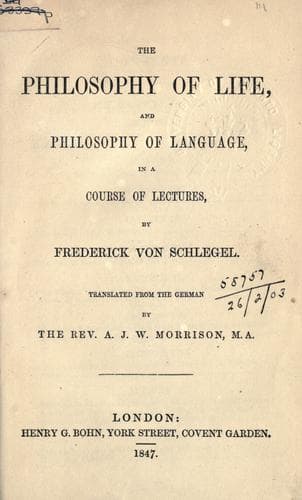
The philosophy of life, and philosophy of language, in a course of lecturesSchlegel, Friedrich von
Philosophy
The philosophy of life, and philosophy of language, in a course of lectures
Schlegel, Friedrich von
Language and languages -- Philosophy; Life; Philosophy
When, however, we turn to its original source--to the historical basis,
_i.e._, to Christian revelation, and derive therefrom the true idea of a
theocracy, we shall find it to be very different from the assumption
which each of these parties tacitly advances as self-evident. The idea
of a theocracy can only be properly determined from the instance of the
Jews. The history of that nation will not only enable us fully to
develop it as an actual form of polity, having an historical origin and
existence, but also in the clearest and readiest way to illustrate it.
Now the passage from revolution, civil war, and anarchy, to absolute
despotism, in its genetic progress, can be most clearly and most
profitably traced in Roman history. The true nature, moreover, of the
dynamical polity can be learned from the historically originated and
historically preserved exemplification of it in England, far better than
from any theory, or from any scheme of a constitution propounded for the
occasion of some state experiment, for all such experiments require the
lasting test of a few generations, or at least of half a century before
any decided opinion can be passed on their success and historical
permanency. And just in the same way the peculiar character and essence
of a theocracy can be deduced from no source so clearly or so fully as
from the Jewish history. Or, rather, the true idea of it can be acquired
from no other channel, since among this people only has a theocracy ever
existed as a real form of national polity. And here it continued in
force for nearly four hundred years.
However poor may be the part which the people of Israel played in the
great drama of the world’s history, in comparison with that of the great
conquering nations, the Persians, Greeks, and Romans, still the
prophetic people (whose importance must be sought only in this
designation, or, in other words, their continual relation to the
future), possesses, even in their peculiar code of laws and form of
government, a remarkable interest for the historian. For in the true
historical estimate of things mere extent of power can not pass for the
exclusive standard of greatness and importance. And this has been
already the judgment of many writers of history, who, as far as regards
this particular subject, and the general question of religion, must
undoubtedly be pronounced free from either prepossession or prejudice.
The way, too, in which this ancient people have survived the destruction
of their national government, and for nearly two thousand years since
have uniformly remained separate from all other nations, has been more
than once confessed to be a very striking phenomenon, unparalleled in
the history of the world.
Public-domain text, read in full here on John Shaqi.
Reviews
Reviews
No reviews yet
Be the first to share your thoughts on this work.
Elsewhere in the archive
Join the Discussion
Join the discussion
Sign in to leave a comment or review.
Sign InorCreate an account