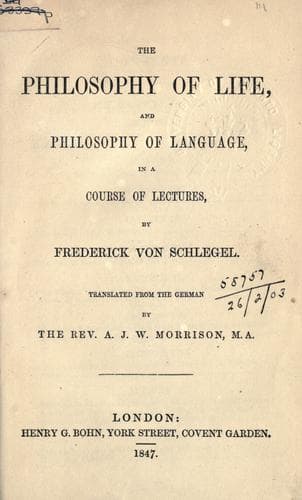
The philosophy of life, and philosophy of language, in a course of lecturesSchlegel, Friedrich von
Philosophy
The philosophy of life, and philosophy of language, in a course of lectures
Schlegel, Friedrich von
Language and languages -- Philosophy; Life; Philosophy
Moses, from whom that theocracy first emanated, or, rather, with whom it
commenced, was not himself the High Priest. His brother Aaron enjoyed
that dignity. He neither wished nor had a title to hold it. He had no
hereditary claim to it, neither was he elected to it by the people. And
yet he stood in no man’s place, nor did he forcibly dispossess any one
of his right. And so even, if for a while we dismiss the theological
view entirely from our regard, and, forgetting it for a moment, judge
of the matter by the strictest juristic notions, we can not call him a
usurper, even in that sense of the term which comprises the demagogue’s
character. At an earlier period of his life, he appeared likely to
become a mere liberator in the usual sense of the word. In this
character, however, he does not appear unjust, even though he allowed
himself to be hurried into an act of violence against a petty tyrant
among the oppressors of his countrymen. And at a later period, when he
had received his call, we can not in his conduct toward the Egyptians
discover any trace of injustice, even judging him by the strictest legal
notions. Now, the authority which Moses exercised over his own people,
while he led them through the wilderness, rested on the immediate
exercise of the divine powers which were lent to him from above, and
which were immediately acknowledged as such, and nowhere met with any
considerable resistance. And, accordingly, properly speaking, no
question was ever raised against a right which was based entirely on
those imparted powers, although they were totally devoid of any formal
or distinct act of legal sanction. The office he held was prophetical.
But by this term I do not mean merely according to its later and more
obvious meaning, the function of warning or promising, of teaching or
predicting, but all this, and something more--a higher and divine power,
which vividly and persuadingly displayed itself in life and deeds.
Looking at it in a general light, and as applied to a case which, at
least, we can think of as not impossible, of the Almighty having sent,
or purposing to send, a second Moses to some other people, then the
circumstance we lately mentioned, that this Moses forcibly dispossessed
no one of his rights, and had made no unrighteous revolution, must be
taken into consideration, even if it might not simply by itself serve as
the characteristic or distinctive test of the genuineness of the
vocation in question.
Public-domain text, read in full here on John Shaqi.
Reviews
Reviews
No reviews yet
Be the first to share your thoughts on this work.
Elsewhere in the archive
Join the Discussion
Join the discussion
Sign in to leave a comment or review.
Sign InorCreate an account