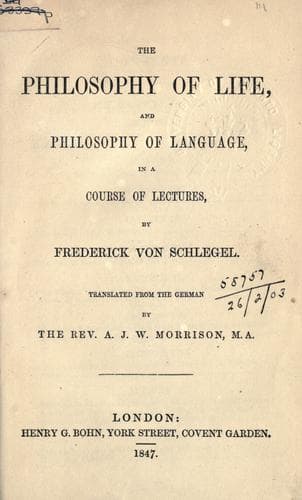
The philosophy of life, and philosophy of language, in a course of lecturesSchlegel, Friedrich von
Philosophy
The philosophy of life, and philosophy of language, in a course of lectures
Schlegel, Friedrich von
Language and languages -- Philosophy; Life; Philosophy
Lastly, we will now consider that other instinct of our nature, which,
even as the strongest, most requires moral regulation and treatment. By
all noble natures among civilized nations, in their best and purest
times, this instinct has, by means of various moral relations, been
spontaneously associated with a higher element. And, indeed, taken
simply as inclination, it possesses some degree of affinity therewith.
Such a strong inclination and hearty love, elevated to the bond of
fidelity, receives thereby a solemn consecration, and is even, according
to the divine dispensation, regarded as a sanctuary. And it is in truth
the moral sanctuary of earthly existence, on which God’s first and
earliest blessing still rests. It is, moreover, the foundation on which
is built the happiness and the moral welfare of races and nations. This
soul-connecting link of love, which constitutes the family union, is the
source from which emanate the strong and beautiful ties of a mother’s
love, of filial duty, and of fraternal affection between brethren and
kindred, which together make up the invisible soul, and, as it were, the
inner vital fluid of the nerves of human society. And here, too, the
great family problem of education must be taken into account--and by
education I mean the whole moral training of the rising generation. For,
however numerous and excellent may be the institutions founded by the
state, or conducted by private individuals, for special branches and
objects, or for particular classes and ages, still, on the whole,
education must be regarded as pre-eminently the business and duty of the
family. For it is in the family that education commences, and there,
also, it terminates and concludes at the moment when the young man,
mature of mind and years, and the grown-up maiden, leave the paternal
roof to found a new family of their own. In seasons of danger, and of
wide-spread and stalking corruption, men are wont to feel--but often,
alas! too late--how entirely the whole frame, both of human and
political society, rests on this foundation of the family union. Not
merely by the phenomena of our own times, but by the examples of the
most civilized nations of antiquity, may this truth be historically
proved; and numerous passages can be adduced from their great historians
in confirmation of it. In all times and in all places a moral revolution
within the domestic circle has preceded the public outbreaks of general
anarchy, which have thrown whole nations into confusion, and undermined
the best-ordered and wisely-constituted states. When all the principal
joists of a building have started, and all its stays and fastenings,
from the roof to the foundation, have become loose, then will the first
storm of accident easily demolish the whole structure, or the first
spark set the dry and rotten edifice in flames.
Public-domain text, read in full here on John Shaqi.
Reviews
Reviews
No reviews yet
Be the first to share your thoughts on this work.
Join the Discussion
Join the discussion
Sign in to leave a comment or review.
Sign InorCreate an account