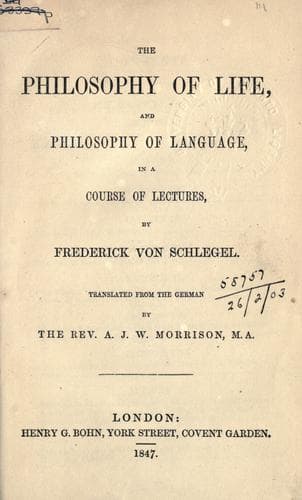
The philosophy of life, and philosophy of language, in a course of lecturesSchlegel, Friedrich von
Philosophy
The philosophy of life, and philosophy of language, in a course of lectures
Schlegel, Friedrich von
Language and languages -- Philosophy; Life; Philosophy
Even supposing that,
in the case of a true love and a genuine enthusiasm, a passing thought
may be detected, a momentary excitement or manifestation which goes
beyond the exact line of the actual truth--even in such a case this love
and this enthusiasm would not therefore be less real and genuine--still
would not all be exaggeration that might seem so to the unsympathizing
and unenthusiastic intellect. At all events, it must ever remain
undeniable, that emergencies occur in human life which are not met by
the rigorous and mathematical formularies of ethical science, and where
by nothing but a noble sacrifice of love far transcending all the common
and general requisitions of the practical reason--by nothing but a lofty
energy and resolute enthusiasm--can a man extricate himself from his
perplexities and arrive at a happy result. At least, it will not do to
overlook or misrepresent this element of human life, even though it must
be admitted that it is not exempt from those traces of human infirmity
which are also but too apparent in the other aspect of it, the one,
viz., in which the formal reason decides every thing, and is supreme.
As, therefore, the thinking soul is the living center of the human
consciousness, so, on the other hand, the loving soul is the middle
point and the foundation of all moral life, as it shows itself in that
soul-bond of love, which, while it constitutes marriage, is tied and
completed therein. On this union, then, which, as historically
represented, appears to be the true commencement of civilized life, it
will be necessary to say a few words; and the present seems the most
appropriate place for them. Now, both in philosophy and in all general
speculation, there are many reasoners who would derive every thing from
material sensations, and seek to degrade all that is regarded as high
and noble by mankind. So here, also, in the world’s mode of judging of
this union--which, however, all publicly-acknowledged principles regard
as holy--it, and all that belongs to it, is accounted for by some
evanescent passion, some sensual impression, or some interested view or
other, while the existence of any thing like true and genuine love is
absolutely denied. But, in the first place, in the case of a union which
embraces the entire man--his sensuous as well as his rational, or, as I
should prefer to say, his earthly no less than his spiritual nature and
temperament--it can not fairly be urged in objection to it, that both
the elements of his mixed constitution are present in it. On the
contrary, it is obviously most unjust, in our estimate of it, violently
to separate what, even in the least corrupted disposition and purest
characters, are most closely interwoven, or, rather, fused together, and
to subject them to an invidious and destructive analysis. This is not
the way to determine the characteristics of a true and of a false love.
The distinction between them must rather be sought by a simpler method,
Public-domain text, read in full here on John Shaqi.
Reviews
Reviews
No reviews yet
Be the first to share your thoughts on this work.
Join the Discussion
Join the discussion
Sign in to leave a comment or review.
Sign InorCreate an account