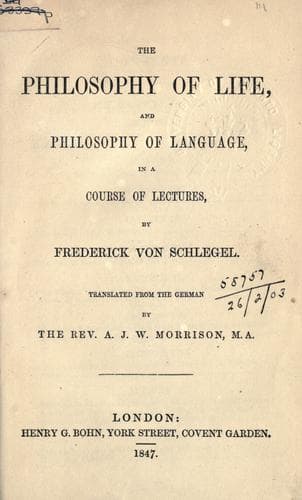
The philosophy of life, and philosophy of language, in a course of lectures — John Shaqi
The philosophy of life, and philosophy of language, in a course of lecturesSchlegel, Friedrich von
Philosophy
The philosophy of life, and philosophy of language, in a course of lectures
Schlegel, Friedrich von
Language and languages -- Philosophy; Life; Philosophy
similar to that which we followed in the case of longing and
enthusiasm--by considering merely the total result. A feeling of this
kind may appear at the beginning never so violent; it may even amuse
itself with a thorough mental hallucination, which betrays itself in its
very outward aspect, with the profoundest veneration, nay, deification
of its admired object; but in married life this intense admiration soon
gives place to satiety or indifference, and imbittered by mutual
distrust and misunderstanding, it terminates in incurable discord. In
such a case the feeling, even in its ardent beginnings, was no true
love, but simply passion. But in those happy unions, where the first
passionate ardor of youth yields only to an ever-growing and still purer
development of mutual good-will and confidence--while self-sacrifice and
patient endurance, both in good and evil fortune, do but cherish the
same deep affection and calm friendship--here, from the very first, it
was true and genuine love. For, however much the outward appearances of
human life may seem to contradict it, there is not in nature, and even
in the higher region, any love without a return. And as all true love
is reciprocal, so also is true love lasting and indestructible; or, to
“speak as a man,” even because it is the very inmost life of humanity,
it is, therefore, true unto death.
Moreover, in the case of a union which extends to the whole of life, it
is quite consistent that a due regard should be paid to the other
circumstances and relations of existence; only no general rule can be
laid down in this respect. This is a matter which has been left to the
discretion of individuals, even by the divine laws, those sacred
guardians of wedlock, which, however, rigorously insist on the absence
of all compulsion, inasmuch as the free consent of all parties is an
essential condition of this union. And as we should be justified in
taking for granted that this reciprocal act of free will must not be any
inconsiderate or extorted assent, or one induced by other interested
feeling or consideration, so is this expressly asserted by the fact
that, according to the spirit of these holy laws of matrimony, this
union must be founded on mutual affection, and regarded as an
indissoluble bond of souls, and not as a mere civil contract or deed of
sale and transfer of rank and property. The latter, as well as all else,
are mere subordinate matters. Three things, according to God’s moral
government of the world, are indispensable to and required by the
essence and spirit of these holy laws. In the first place, there must be
a mutual consent of the will--a reciprocal fondness and liking, to which
the will, whenever it is left free and unshackled, gives an appropriate
utterance and expression. In the second place, these laws require that
unison of temper which is indispensable to its permanence; while,
thirdly and lastly, they provide that this union, so sacred in the sight
Public-domain text, read in full here on John Shaqi.
Reviews
Reviews
No reviews yet
Be the first to share your thoughts on this work.
Join the Discussion
Join the discussion
Sign in to leave a comment or review.
Sign InorCreate an account