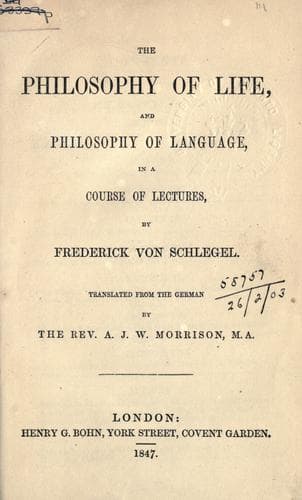
The philosophy of life, and philosophy of language, in a course of lecturesSchlegel, Friedrich von
Philosophy
The philosophy of life, and philosophy of language, in a course of lectures
Schlegel, Friedrich von
Language and languages -- Philosophy; Life; Philosophy
A few illustrations, drawn from daily experience, will, perhaps, serve
to explain my meaning. Generally speaking, the most important arts and
pursuits of life are ultimately based on mathematics. This science
furnishes them, as it were, with the method they observe; but it is not
practicable, nor, indeed, has man the leisure, to revert on every
occasion, with methodical exactness, to these elements, but, assuming
the principles to be well known and admitted, he attends rather to the
results essential to the end he has in view. The economical management
of the smallest as well as of the largest household, rests, in the end,
on the elementary principles of arithmetic; but what would come of it
if, on every occasion, we were to go back to the simple “one-times-one”
of the multiplication table, and reflected upon and sought for the
proofs that the principle is really valid and can confidently be relied
on in practice? In the same way the art of war is founded on geometry;
but when the general arranges his troops for battle, does he consult his
Euclid to satisfy himself of the correctness and advantages of his
position? Lastly, when the astronomer, whose vocation is pre-eminently
dependent on accurate calculation, when he would make us acquainted with
the phenomena of the sidereal heavens, confines himself almost entirely
to them, without wearying those whom he wishes to interest, with the
complicated reckonings which, however, in all probability, he was
obliged himself to go through. With all these arts and pursuits of
practical life, the intellectual business of thinking--of such thinking
at least as is common to most men--and of communicating thought, has a
sort of affinity and resemblance. For, unquestionably, it is one among
the many problems of philosophy to establish a wise economy and prudent
stewardship of that ever-shifting mass of incoming and outgoing thoughts
which make up our intellectual estate and property. And this is the more
necessary the greater are the treasures of thought possessed by our age.
For, in the highly rapid interchange of and traffic in ideas, which is
carrying on, the receipts and disbursements are not always duly
balanced. There is much cause, therefore, to fear lest a thoughtless and
lavish dissipation of the noblest mental endowments should become
prevalent, or a false and baseless credit-system in thought spring up
amid an absolute deficiency of a solid and permanent capital safely
invested in fundamental ideas and lasting truths. As for the second
simile: I should, by all means, wish to gain a victory, not indeed for
you, but with you, over some of the many errors and many semblances of
thought, which are, however, but cheats and counterfeits which distract
the minds of the present generation, disturb the harmony of life, and
banish peace even from the intellectual world. And as respects the third
illustration: I should indeed rejoice as having, in a great measure,
Public-domain text, read in full here on John Shaqi.
Reviews
Reviews
No reviews yet
Be the first to share your thoughts on this work.
Join the Discussion
Join the discussion
Sign in to leave a comment or review.
Sign InorCreate an account