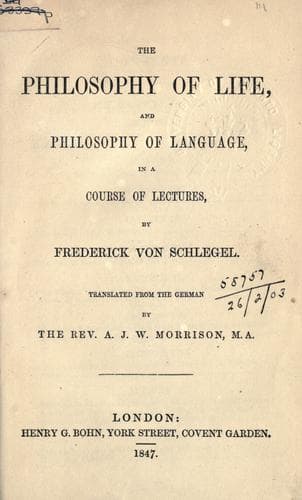
The philosophy of life, and philosophy of language, in a course of lectures — John Shaqi
The philosophy of life, and philosophy of language, in a course of lecturesSchlegel, Friedrich von
Philosophy
The philosophy of life, and philosophy of language, in a course of lectures
Schlegel, Friedrich von
Language and languages -- Philosophy; Life; Philosophy
attained my object, if only I shall succeed in directing your attention
to some star in the higher region of intellect, which hitherto was
either totally unknown, or, at least, never before fully observed.
But above all, I think it necessary to observe further, that in the same
way as philosophy loses sight of its true object and appropriate matter,
when either it passes into and merges in theology, or meddles with
external politics, so also does it mar its proper form when it attempts
to mimic the rigorous method of mathematics. In the middle of the last
century scarcely was there to be found a German manual for any of the
sciences that did not ape the mathematical style, and where every single
position in the long array of interminable paragraphs did not conclude
with the solemn act of demonstrative phraseology. But it is also well
known that the philosophy which was propounded in this inappropriate
form and method was crammed full of, nay, rather, was hardly any thing
more than a tissue of arbitrary, now forgotten, hypotheses, which have
not brought the world at all nearer to the truth--not at least to that
truth which philosophy is in search of, and which is something higher
than a mere example of accurate computation.
And even in the present day--although, indeed, the application is made
in a very different way from formerly--German philosophy is any thing
but free from those algebraic formularies, in which all things, even the
most opposite, admit of being comprised and blended together. But, be it
as it may, this elaborate structure of mechanical demonstration can
never produce a true, intrinsic, and full conviction. The method which
philosophy really requires is quite different, being absolutely internal
and intellectual (_geistige_). As in a correct architectural structure
it is necessary that all its parts should be in unison, and such as the
eye can take in easily and agreeably, so in every philosophical
communication, the solid simple basis being laid, the arrangement of all
the parts, and the careful rejection and exclusion of all foreign
matter, is the most essential point, both for internal correctness and
external perspicuity. But, in truth, the matter in hand bears a far
closer resemblance and affinity to natural objects which live and grow,
than to any lifeless edifice of stone; to a great tree, for instance,
nobly and beautifully spreading out on all sides in its many arms and
branches. As such a tree strikes the hasty and passing glance, it forms
a somewhat irregular and not strictly finished whole; there it stands,
just as the stem has shot up from the root, and has divided itself into
a certain number of branches, and twigs, and leaves, which livingly move
backward and forward in the free air. But examine it more closely, and
how perfect appears its whole structure! how wonderful the symmetry, how
minutely regular the organization of all its parts, even of each little
Public-domain text, read in full here on John Shaqi.
Reviews
Reviews
No reviews yet
Be the first to share your thoughts on this work.
Join the Discussion
Join the discussion
Sign in to leave a comment or review.
Sign InorCreate an account