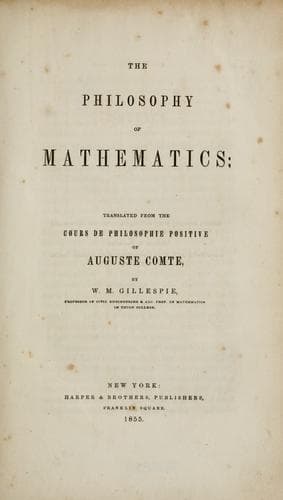
The pleasure and profit which the translator has received from the great
work here presented, have induced him to lay it before his
fellow-teachers and students of Mathematics in a more accessible form
than that in which it has hitherto appeared. The want of a comprehensive
map of the wide region of mathematical science--a bird's-eye view of its
leading features, and of the true bearings and relations of all its
parts--is felt by every thoughtful student. He is like the visitor to a
great city, who gets no just idea of its extent and situation till he
has seen it from some commanding eminence. To have a panoramic view of
the whole district--presenting at one glance all the parts in due
co-ordination, and the darkest nooks clearly shown--is invaluable to
either traveller or student. It is this which has been most perfectly
accomplished for mathematical science by the author whose work is here
presented.
Clearness and depth, comprehensiveness and precision, have never,
perhaps, been so remarkably united as in AUGUSTE COMTE. He views his
subject from an elevation which gives to each part of the complex whole
its true position and value, while his telescopic glance loses none of
the needful details, and not only itself pierces to the heart of the
matter, but converts its opaqueness into such transparent crystal, that
other eyes are enabled to see as deeply into it as his own.
Any mathematician who peruses this volume will need no other
justification of the high opinion here expressed; but others may
appreciate the following endorsements of well-known authorities. _Mill_,
in his "Logic," calls the work of M. Comte "by far the greatest yet
produced on the Philosophy of the sciences;" and adds, "of this
admirable work, one of the most admirable portions is that in which he
may truly be said to have created the Philosophy of the higher
Mathematics:" _Morell_, in his "Speculative Philosophy of Europe," says,
"The classification given of the sciences at large, and their regular
order of development, is unquestionably a master-piece of scientific
thinking, as simple as it is comprehensive;" and _Lewes_, in his
"Biographical History of Philosophy," names Comte "the Bacon of the
nineteenth century," and says, "I unhesitatingly record my conviction
that this is the greatest work of our age."
Public-domain text, read in full here on John Shaqi.
Reviews
Reviews
No reviews yet
Be the first to share your thoughts on this work.
Join the Discussion
Join the discussion
Sign in to leave a comment or review.
Sign InorCreate an account