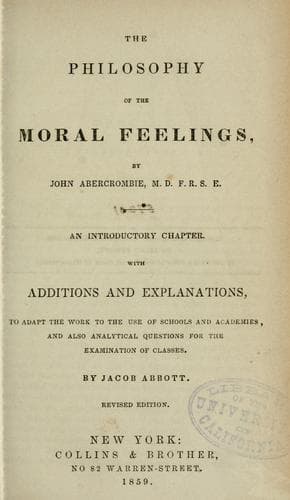
The Philosophy of the Moral FeelingsAbercrombie, John
Religion
The Philosophy of the Moral Feelings
Abercrombie, John
Ethics
beauty, order, and harmony are seen to pervade the government of the
Deity. In this manner there also arises a species of evidence for the
doctrines of revelation, which is entirely independent of the external
proofs of its divine origin; and which, to the candid mind, invests it
with all the characters of authenticity and truth.
From these combined sources of knowledge, thus illustrating and
confirming each other, we are enabled to attain, in moral inquiries, a
degree of certainty adapted to their high importance. We do so when,
with sincere desire to discover the truth, we resign ourselves to the
guidance of the light which is within, aided as it is by that light from
heaven which shines upon the path of the humble inquirer. Cultivated on
these principles, the science is fitted to engage the most powerful
mind; while it will impart strength to the most common understanding. It
terminates in no barren speculations, but tends directly to promote
peace on earth, and good-will among men. It is calculated both to
enlarge the understanding, and to elevate and purify the feelings, and
thus to cultivate the moral being for the life which is to come. It
spreads forth to the view, becoming smoother and brighter the farther it
is pursued; and the rays which illuminate the path converge in the
throne of Him who is Eternal.
SECT. II.
OF FIRST TRUTHS IN THE PHILOSOPHY OF THE MORAL FEELINGS.
The knowledge which we receive through our intellectual powers is
referable to two classes. These may be distinguished by the names of
acquired knowledge, and intuitive or fundamental articles of belief. The
former is procured by the active use of our mental powers, in collecting
facts, tracing their relations, and observing the deductions which arise
out of particular combinations of them. These constitute the operations
which I have referred to in another work, under the heads of processes
of investigation, and processes of reasoning. The full exercise of them
requires a certain culture of the mental faculties, and consequently is
confined to a comparatively small number of men. We perceive, however,
that such culture is not essential to every individual,--for many are
very deficient in it who yet are considered as persons of sound mind,
and capable of discharging their duties in various situations of life in
a creditable and useful manner.
Public-domain text, read in full here on John Shaqi.
Reviews
Reviews
No reviews yet
Be the first to share your thoughts on this work.
Join the Discussion
Join the discussion
Sign in to leave a comment or review.
Sign InorCreate an account