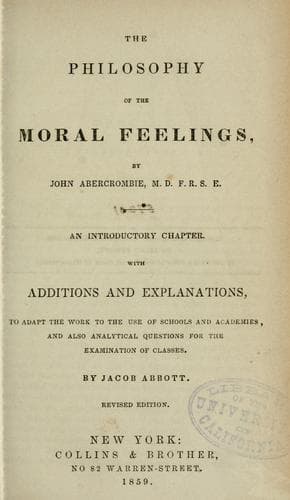
The Philosophy of the Moral FeelingsAbercrombie, John
Religion
The Philosophy of the Moral Feelings
Abercrombie, John
Ethics
But the knowledge which we derive from the other source is of immediate
and essential importance to men of every degree; and, without it, no
individual could engage, with confidence, in any of the common
transactions of life, or make any provision for his protection or
comfort, or even for the continuance of his existence. These are the
principles also treated of, in a former work, under the name of First
Truths. They are not, like our knowledge of the other kind, the result
of any process either of investigation or of reasoning, and, for the
possession of them, no man either depends upon his own observation, or
has recourse to that of other men. They are a part of his mental
constitution, arising, with a feeling of absolute certainty, in every
sound mind; and, while they admit of no proof by processes of reasoning,
sophistical objections brought against them can be combated only by an
appeal to the consciousness of every man, and to the absolute conviction
which forces itself upon the whole mass of mankind.
If the Creator has thus implanted in the mind of man principles to guide
him in his intellectual and physical relations, independently of any
acquired knowledge, we might naturally expect to find him endowed, in
the same manner, with principles adapted to his more important relations
as a moral being. We might naturally expect, that, in these high
concerns, he would not be left to the knowledge which he might casually
acquire, either through his own powers of investigation or reasoning, or
through instruction received from other men. Impressions adapted to this
important end we accordingly find developed in a remarkable manner,--and
they are referable to that part of our constitution, which holds so
important a place in the philosophy of the mind, by which we perceive
differences in the moral aspect of actions, and approve or disapprove of
them as right or wrong. The convictions derived from this source seem to
occupy the same place in the moral system, that first truths, or
intuitive articles of belief, do in the intellectual. Like them, also,
they admit of no direct proofs by processes of reasoning; and, when
sophistical arguments are brought against them, the only true answer
consists in an appeal to the conscience of every uncontaminated
mind;--by which we mean chiefly the consciousness of its own moral
impressions, in a mind which has not been degraded in its moral
perceptions by a course of personal depravity. This is a consideration
of the utmost practical importance; and it will probably appear that
many well-intended arguments, respecting the first principles of moral
truth, have been inconclusive, in the same manner as were attempts to
establish first truths by processes of reasoning,--because the line of
argument adopted in regard to them was one of which they are not
susceptible. The force of this analogy is in no degree weakened by the
fact, that there is, in many cases, an apparent difference between that
Public-domain text, read in full here on John Shaqi.
Reviews
Reviews
No reviews yet
Be the first to share your thoughts on this work.
Join the Discussion
Join the discussion
Sign in to leave a comment or review.
Sign InorCreate an account