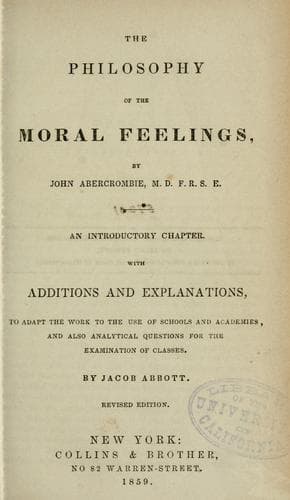
The Philosophy of the Moral FeelingsAbercrombie, John
Religion
The Philosophy of the Moral Feelings
Abercrombie, John
Ethics
the most minute and scrupulous anxiety, to discover whether the case
involves any principle of duty,--and a similar anxiety in acting
suitably when he has discovered it. This is what we call a strictly
conscientious man. Another, who shews no want of a proper sense of duty
when the line is clearly drawn, has less anxiety in such cases as these,
and may sacrifice minute or doubtful points to some other feeling,--as
self-interest or even friendship,--where the former individual might
have discovered a principle of duty.
Reason is also concerned in judging of a description of cases, in which
a modification of moral feeling arises from the complexity of
actions,--or, in other words, from the circumstances in which the
individual is placed. This may be illustrated by the difference of moral
sentiment which we attach to the act of taking away the life of
another,--when this is done by an individual under the impulse of
revenge,--by the same individual in self-defence,--or by a judge in the
discharge of his public duty.
There is still another office frequently assigned to Reason in moral
decisions,--as when we speak of a man acting upon Reason as opposed to
passion. This however is, correctly speaking, only a different use of
the term; and it means that he acts upon a calm consideration of the
motives by which he ought to be influenced, instead of being hurried
away by a desire or an affection which has been allowed to usurp undue
influence.
* * * * *
The important distinction, therefore, which these observations have been
intended to illustrate, may be briefly recapitulated in the following
manner. Our impression of the aspect of actions, as right or wrong, is
conveyed by a principle in the human mind entirely distinct from a
simple exercise of reason,--and the standard of moral rectitude derived
from this source is, in its own nature, fixed and immutable. But there
are many cases in which an exercise of reason may be employed, in
referring particular actions to this standard, or trying them, as it
were, by means of it. Any such mental process, however, is only to be
considered as a kind of test applied to individual instances, and must
not be confounded with the standard to which it is the office of this
test to refer them. Right or virtuous conduct does, in point of fact,
contribute to general utility, as well as to the advantage of the
individual, in the true and extended sense of that term, and these
tendencies are perceived by Reason. But it is neither of these that
constitutes it right. This is founded entirely on a different
principle,--the immutable rule of moral rectitude; it is perceived by a
different part of our constitution,--the moral principle, or conscience;
and, by the operation of this principle, we pronounce it right, without
any reference to its consequences either to ourselves or others.
* * * * *
Public-domain text, read in full here on John Shaqi.
Reviews
Reviews
No reviews yet
Be the first to share your thoughts on this work.
Elsewhere in the archive
Join the Discussion
Join the discussion
Sign in to leave a comment or review.
Sign InorCreate an account