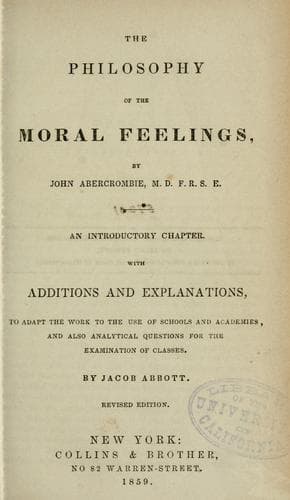
The Philosophy of the Moral FeelingsAbercrombie, John
Religion
The Philosophy of the Moral Feelings
Abercrombie, John
Ethics
The preceding observations, on Conscience, I leave nearly as they stood
in the second edition of this volume. Since the publication of that
edition, I have seen various discussions of this important question, but
have found nothing to alter the opinion I have expressed, respecting the
nature and the authority of conscience as an original principle in our
moral constitution; and I see no system by which we can escape from the
numerous difficulties surrounding every other view of the subject. In
particular, I cannot perceive what is gained by those who refer our
moral decisions to a process of reason or judgment alone. For by
judgment, in the ordinary and recognised acceptation of the term, I can
understand nothing more than a power of comparing two or more facts or
impressions together, and tracing their relations. When we apply such a
mental process to a question of morals, it can amount to nothing more
than a comparison of our conduct with some standard. If those who hold
the doctrine referred to, mean any thing more than this,--if they allow
the mind a power of moral decision independently of any such standard,
then this is precisely what we mean by conscience, and the controversy
resolves itself, like not a few that have gone before it, into a dispute
about a name. If they do not allow the mind such a power, it then
becomes them to say, what is the standard by which its moral judgments
are to be formed, and whence it is derived. It appears, I think,
distinctly, that it can be derived only from one of two sources. It must
either be received through divine revelation; or it must be the result
of our speculations respecting utility, in one or other of the forms in
which that doctrine is presented to us. There does not appear to be any
middle course; and accordingly some late writers, who reject the latter
system, while they do not admit the authority of conscience, seem to
refer our moral impressions entirely to the will of the Deity as made
known to us by revelation. I have formerly stated what seem to me to be
insuperable objections to this doctrine. It appears, indeed, to be
distinctly opposed by the very words of Scripture, which clearly
recognise a power, or a process in the mind by which "those who are
without law," that is, without a revelation, "are a law unto themselves,
their consciences bearing witness, and their thoughts accusing or else
excusing one another."
Public-domain text, read in full here on John Shaqi.
Reviews
Reviews
No reviews yet
Be the first to share your thoughts on this work.
Elsewhere in the archive
Join the Discussion
Join the discussion
Sign in to leave a comment or review.
Sign InorCreate an account