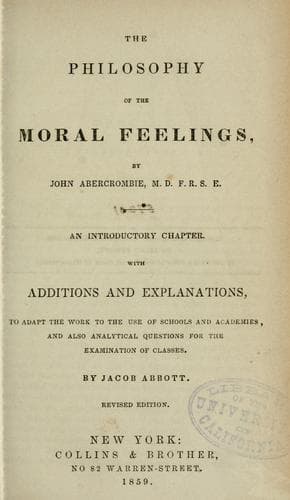
The Philosophy of the Moral FeelingsAbercrombie, John
Religion
The Philosophy of the Moral Feelings
Abercrombie, John
Ethics
If we would seek for that, which must be of all conceivable things of
the highest moment both for the peace and the improvement of the moral
being, it is to be found in the habit of mind, in which there is the
uniform contemplation of the divine character, with a constant reliance
on the guidance of the Almighty in every action of life. "One thing,"
says an inspired writer, "have I desired of the Lord, that will I seek
after; that I may dwell in the house of the Lord all the days of my
life, to behold the beauty of the Lord, and to inquire in his
temple."--The man, who thus cultivates the habitual impression of the
divine presence, lives in an atmosphere peculiarly his own. The storms
which agitate the lower world may blow around or beneath, but they
touch not him;--as the traveller has seen from the mountain's top the
war of elements below, while he stood in unclouded sunshine. In the
works, and ways, and perfections of the Eternal One, he finds a subject
of exalted contemplation, in comparison with which the highest inquiries
of human science sink into insignificance. It is an exercise, also,
which tends at once to elevate and to purify the mind. It raises us from
the minor concerns and transient interests which are so apt to occupy
us,--to that wondrous field in which "worlds on worlds compose one
universe,"--and to that mind which bade them move in their appointed
orbits, and maintains them all in undeviating harmony. While it thus
teaches us to bend in humble adoration before a wisdom which we cannot
fathom, and a power which we cannot comprehend, it directs our attention
to a display of moral attributes which at once challenge our reverence
and demand our imitation. By thus leading us to compare ourselves with
the supreme excellence, it tends to produce true humility, and, at the
same time, that habitual aspiration after moral improvement which
constitutes the highest state of man. "The proud," says an eloquent
writer, "look down upon the earth, and see nothing that creeps upon its
surface more noble than themselves;--the humble look upwards to their
God." This disposition of mind, so far from being opposed to the
acquirements of philosophy, sits with peculiar grace upon the man who,
through the most zealous cultivation of human science, ascends to the
Eternal Cause. The farther he advances in the wonders of nature, the
higher he rises in his adoration of the power and the wisdom which guide
the whole;--"Where others see a sun, he sees a Deity." And then, in
every step of life, whether of danger, distress, or difficulty, the man
who cultivates this intercourse with the incomprehensible One "inquires
in his temple." He inquires for the guidance of divine wisdom, and the
strength of divine aid, in his progress through the state of moral
discipline;--he inquires, in a peculiar manner, for this aid in the
culture of his moral being, when he views this mighty undertaking in its
Public-domain text, read in full here on John Shaqi.
Reviews
Reviews
No reviews yet
Be the first to share your thoughts on this work.
Elsewhere in the archive
Join the Discussion
Join the discussion
Sign in to leave a comment or review.
Sign InorCreate an account