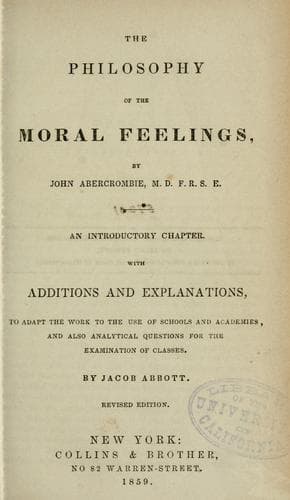
The Philosophy of the Moral FeelingsAbercrombie, John
Religion
The Philosophy of the Moral Feelings
Abercrombie, John
Ethics
results, not to the mere possession of these qualities, but to the
efforts which naturally arose from them, in the circumstances in which
the individual was placed. And, when the inspired writer says, that
without faith it is impossible to please God,--he certainly refers to no
mere mental impression, and to no barren system of opinions; but to the
reception of certain truths, which in our present state of being are
entirely the objects of faith, and to all that influence, upon the moral
feelings and the character, which these must produce upon every mind
that really believes them.
* * * * *
On this great subject, much misconception appears to have arisen from
not sufficiently attending to the condition in which, as moral beings,
we are placed in the present state of existence, and the important part
which must be performed by the mental exercise called faith. As physical
and intellectual beings, we have certain relations to the objects by
which we are surrounded, and with these we communicate by means of our
bodily senses. But, as moral beings, our relations are entirely of a
different nature; and the facts and motives, which are calculated to act
upon us in these relations, are chiefly the objects of faith: that is,
they are not cognizable by any of our senses, but are to be received by
a different part of our constitution, and upon a separate kind of
evidence. This, accordingly, is the simple but important distinction,
referred to by the sacred writer, when, in allusion to our condition as
moral beings, he says,--"we walk by faith, not by sight." The objects of
sight, here intended to express all the objects of sense, exercise over
us a habitual and powerful influence. They constantly obtrude themselves
upon our notice without any exertion of our own; and it requires a
peculiar exercise of mind to withdraw our attention from them, and to
feel the power of events which are future, and of things which are not
seen. This mental exercise is Faith. Its special province, as we have
seen, is to receive truths which are presented directly to the mind,--to
place them before us with all the vividness of actual and present
existence,--and to make them exert upon us an agency analogous to that
which is produced by objects of sight. The next great point in our
inquiry, therefore, is, what are the truths which are calculated thus to
operate upon us as moral beings, and which it is the object of faith to
bring habitually before us.
* * * * *
Public-domain text, read in full here on John Shaqi.
Reviews
Reviews
No reviews yet
Be the first to share your thoughts on this work.
Elsewhere in the archive
Join the Discussion
Join the discussion
Sign in to leave a comment or review.
Sign InorCreate an account