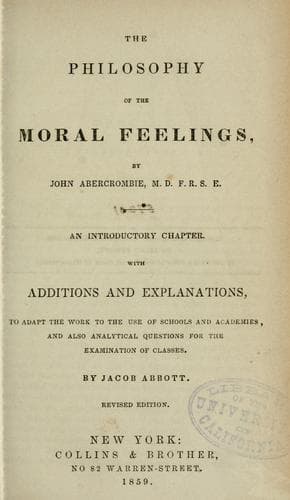
The Philosophy of the Moral FeelingsAbercrombie, John
Religion
The Philosophy of the Moral Feelings
Abercrombie, John
Ethics
In applying to these important articles of belief the name of First
Truths, or primary principles of moral conviction, I do not mean to
ascribe to them any thing of the nature of innate ideas. I mean only
that they arise, with a rapid or instantaneous conviction entirely
distinct from what we call a process of reasoning, in every regulated
mind, when it is directed, by the most simple course of reflection, to
the phenomena of nature without, and to the moral feelings of which it
is conscious within. It appears to be a point of the utmost practical
importance, that we should consider them as thus arising out of
principles which form a part of our moral constitution; as it is in
this way only that we can consider them as calculated to influence the
mass of mankind. For, if we do not believe them to arise, in this
manner, by the spontaneous exercise of every uncorrupted mind, there are
only two methods by which we can suppose them to originate;--the one is
a direct revelation from the Deity,--the other is a process of reasoning
or of investigation, properly so called, analogous to that by which we
acquire the knowledge of any principle in natural science. We cannot
believe that they are derived entirely from revelation, because we find
the belief existing where no revelation is known, and because we find
the sacred writers appealing to them as sources of conviction existing
in the mental constitution of every man. There is an obvious absurdity,
again, in supposing that principles, which are to regulate the conduct
of responsible beings, should be left to the chance of being unfolded by
processes of reasoning, in which different minds may arrive at different
conclusions, and in regard to which many are incapable of following out
any argument at all. What is called the argument _a priori_ for the
existence and attributes of the Deity, for instance, conveys little
that is conclusive to most minds, and to many is entirely
incomprehensible. The same observation may be applied to those
well-intended and able arguments, by which the probability of a future
state is shewn from analogy and from the constitution of the mind. These
are founded chiefly on three considerations,--the tendency of virtue to
produce happiness, and of vice to be followed by misery,--the unequal
distribution of good and evil in the present life,--and the adaptation
of our moral faculties to a state of being very different from that in
which we are at present placed. There is much in these arguments
calculated to elevate our conceptions of our condition as moral beings,
and of that future state of existence for which we are destined; and
there is much scope for the highest powers of reasoning, in shewing the
accordance of these truths with the soundest inductions of true
philosophy. But, notwithstanding all their truth and all their utility,
it may be doubted whether they are to any one the foundation of his
faith in another state of being. It must be admitted, at least, that
Public-domain text, read in full here on John Shaqi.
Reviews
Reviews
No reviews yet
Be the first to share your thoughts on this work.
Join the Discussion
Join the discussion
Sign in to leave a comment or review.
Sign InorCreate an account