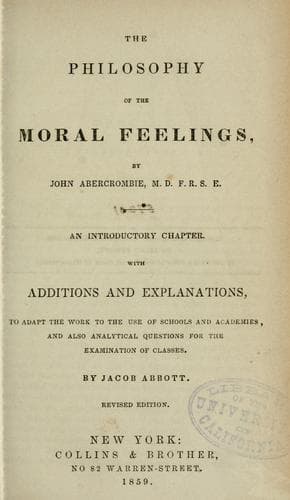
The Philosophy of the Moral FeelingsAbercrombie, John
Religion
The Philosophy of the Moral Feelings
Abercrombie, John
Ethics
II. From this primary moral impression, there arises, by a most natural
sequence, a conviction of the existence and superintendence of a great
moral Governor of the universe,--a being of infinite perfection and
infinite purity. A belief in this Being, as the first great cause, is
derived, as we have formerly seen, by a simple step of reasoning, from a
survey of the works of nature, taken in connexion with the First Truth,
that every event must have an adequate cause. Our sense of his moral
attributes arises, with a feeling of equal certainty, when, from the
moral impressions of our own minds, we infer the moral attributes of him
who thus formed us.
III. From these combined impressions, there naturally springs a sense of
moral responsibility;--or a conviction, that, for the due performance of
the duties which are indicated by the conscience, or moral
consciousness, man is responsible to the Governor of the universe;--and
farther, that to this Being he owes, more immediately, a certain homage
of the moral feelings, entirely distinct from the duties which he owes
to his fellow-men.
IV. From this chain of moral convictions, it is impossible to separate a
deep impression of continued existence, or of a state of being beyond
the present life,--and of that as a state of moral retribution.
* * * * *
The consideration of these important objects of belief will afterwards
occur to us in various parts of our inquiry. They are briefly stated
here, in reference to the place which they hold as First Truths, or
primary articles of moral belief, which arise by a natural and obvious
chain of sequence, in the moral conviction of every sound understanding.
For the truth of them we appeal not to any process of reasoning,
properly so called, but to the conviction which forces itself upon every
regulated mind. Neither do we go abroad among savage nations, to inquire
whether the impression of them be universal; for this may be obscured in
communities, as it is in individuals, by a course of moral degradation.
We appeal to the casuist himself, whether, in the calm moment of
reflection, he can divest himself of their power. We appeal to the
feelings of the man who, under the consciousness of guilt, shrinks from
the dread of a present Deity and the anticipation of a future reckoning.
But chiefly we appeal to the conviction of him, in whom conscience
retains its rightful supremacy, and who habitually cherishes these
momentous truths, as his guides in this life in its relation to the life
that is to come.
Public-domain text, read in full here on John Shaqi.
Reviews
Reviews
No reviews yet
Be the first to share your thoughts on this work.
Join the Discussion
Join the discussion
Sign in to leave a comment or review.
Sign InorCreate an account