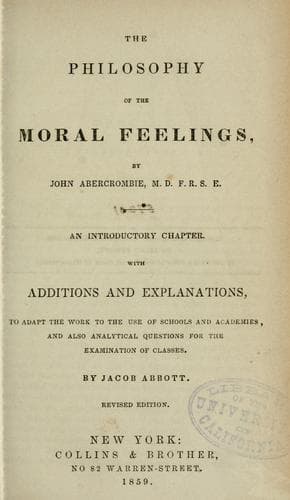
The Philosophy of the Moral FeelingsAbercrombie, John
Religion
The Philosophy of the Moral Feelings
Abercrombie, John
Ethics
Similar observations apply to the uniformity of moral distinctions, or
the conviction of a certain line of conduct which man owes to his
fellow-men. There have been many controversies and various contending
systems in reference to this subject, but I submit that the question may
be disposed of in the same manner as the one now mentioned. Certain
fixed and defined principles of relative duty appear to be recognised by
the consent of mankind, as an essential part of their moral
constitution, by as absolute a conviction as that by which are
recognised our bodily qualities. The hardened criminal, whose life has
been a course of injustice and fraud, when at length brought into
circumstances which expose him to the knowledge or the retribution of
his fellow-men, expects from them veracity and justice, or perhaps even
throws himself upon their mercy. He thus recognises such principles as a
part of the moral constitution, just as the blind man, when he has
missed his way, asks direction of the first person he meets,--presuming
upon the latter possessing a sense which, though lost to him, he still
considers as belonging to every sound man. In defending himself, also,
the criminal shews the same recognition. For, his object is to disprove
the alleged facts, or to frame excuses for his conduct;--he never
attempts to question those universal principles by which he feels that
his actions must be condemned, if the facts are proved against him.
Without such principles, indeed, thus universally recognised, it is
evident that the whole system of human things would go into confusion
and ruin. Human laws may restrain or punish gross acts of violence and
injustice; but they can never provide for numberless methods by which a
man may injure his neighbour, or promote his own interest at the expense
of others. There are, in fact, but a very few cases which can be
provided for by any human institution; it is a principle within that
regulates the whole moral economy. In its extent and importance, when
compared with all the devices of man, it may be likened to those great
principles which guide the movements of the universe, contrasted with
the contrivances by which men produce particular results for their own
convenience; and one might as well expect to move a planet by machinery,
or propel a comet by the power of steam, as to preserve the semblance of
order in the moral world, without those fundamental principles of
rectitude which form a part of the original constitution of every
rational being.
Public-domain text, read in full here on John Shaqi.
Reviews
Reviews
No reviews yet
Be the first to share your thoughts on this work.
Join the Discussion
Join the discussion
Sign in to leave a comment or review.
Sign InorCreate an account