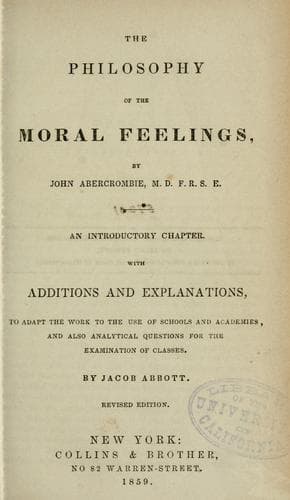
The Philosophy of the Moral FeelingsAbercrombie, John
Religion
The Philosophy of the Moral Feelings
Abercrombie, John
Ethics
Farther, as each man has the consciousness of these principles in
himself, he has the conviction that similar principles exist in others.
Hence arises the impression, that, as he judges of their conduct by his
own moral feelings, so will they judge of him by corresponding feelings
in themselves. In this manner is produced that reciprocity of moral
impression, by which a man feels the opinion of his fellow-men to be
either a reward or a punishment; and hence also springs that great rule
of relative duty, which teaches us to do to others as we would that they
should do to us. This uniformity of moral feeling and affection even
proves a check upon those who have subdued the influence of these
feelings in themselves. Thus, a man who has thrown off all sense of
justice, compassion, or benevolence, is still kept under a certain
degree of control by the conviction of these impressions existing in
those by whom he is surrounded. There are indeed men in the world, as
has been remarked by Butler, in whom this appears to be the only
restraint to which their conduct is subjected.
Upon the whole, therefore, there seems to be ground for assuming, that
the articles of belief, which have been the subject of the preceding
observations, are primary principles arising with an immediate feeling
of conviction in our moral constitution; and that they correspond with
those elements in our intellectual economy, which are commonly called
First Truths,--principles which are now universally admitted to require
no other evidence than the conviction which forces itself upon every
sound understanding.
PHILOSOPHY
OF
THE MORAL FEELINGS.
When we analyze the principles which distinguish man as a moral being,
our attention is first directed to his actions, as the external
phenomena by which we judge of his internal principles. It is familiar
to every one, however, that the same action may proceed from very
different motives, and that, when we have the means of estimating
motives or principles, it is from these that we form our judgment
respecting the moral condition of the individual, and not from his
actions alone. When we consider separately the elements which enter into
the economy of an intelligent and responsible agent, they seem to
resolve themselves into the following:--
I. His actual conduct, or actions.
II. In determining his conduct, the immediate principle is his will, or
simple volition. He wills some act,--and the act follows of course,
unless it be prevented by restraint from without, or by physical
inability to perform it. These alone can interfere with a man following
the determination of his will, or simple volition.
Public-domain text, read in full here on John Shaqi.
Reviews
Reviews
No reviews yet
Be the first to share your thoughts on this work.
Join the Discussion
Join the discussion
Sign in to leave a comment or review.
Sign InorCreate an account