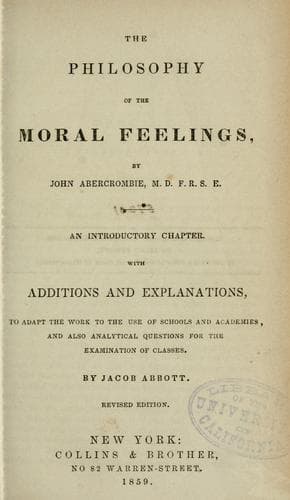
The Philosophy of the Moral FeelingsAbercrombie, John
Religion
The Philosophy of the Moral Feelings
Abercrombie, John
Ethics
(1.) The determination or decision may arise out of a certain state of
arrangement of the moving powers themselves, in consequence of which
some one of them has acquired a predominating influence in the moral
system. This usually results from habit, or frequent indulgence, as we
shall see in a subsequent part of our inquiry. A man, for example, may
desire an object, but perceive that the attainment would require a
degree of exertion greater than he is disposed to devote to it. This is
the preponderating love of ease, a branch of self-love. Another may
perceive that the gratification would impair his good name, or the
estimation in which he is anxious to stand in the eyes of other
men;--this is the predominating love of approbation, or regard to
character. In the same manner, a third may feel that it would interfere
with his schemes of avarice or ambition,--and so in regard to the other
desires. On a similar principle, a man may experience a strong impulse
of anger, but perceive that there would be danger in gratifying it, or
that he would promote his reputation or his interest by not acting upon
it;--he may experience a benevolent affection, but feel that the
exercise would interfere too much with his personal interest or comfort.
(2.) The determination may arise from a sense of duty, or an impression
of moral rectitude, apart from every consideration of a personal nature.
This is the _Moral Principle_ or _Conscience_;--in every mind in a state
of moral health, it is the supreme and regulating principle, preserving
among the moving powers a certain harmony to each other, and to the
principles of moral rectitude. It often excites to conduct which
requires a sacrifice of self-love, and so prevents this principle from
interfering with the sound exercise of the affections. It regulates the
desires, and restrains them by the simple rule of purity;--it directs
and regulates the affections in the same manner by the high sense of
moral responsibility; and it thus maintains order and harmony in the
whole moral system.
One of the chief diversities of human character, indeed, arises from the
circumstance of one man being habitually influenced by the simple and
straight-forward principle of duty, and another merely by a kind of
contest between desires and motives of a very inferior or selfish
nature. Thus also we acquire a knowledge of the moral temperament of
different men, and learn to adapt our measures accordingly in our
transactions with them. In endeavouring, for example, to excite three
individuals to some act of usefulness, we come to know, that in one we
have only to appeal to his sense of duty; in another to his vanity or
love of approbation; while we have no hope of making any impression on
the third, unless we can make it appear to bear upon his interest.
Public-domain text, read in full here on John Shaqi.
Reviews
Reviews
No reviews yet
Be the first to share your thoughts on this work.
Join the Discussion
Join the discussion
Sign in to leave a comment or review.
Sign InorCreate an account