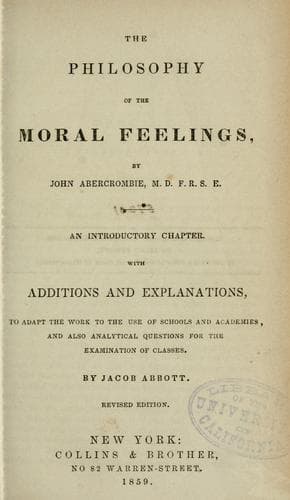
The Philosophy of the Moral FeelingsAbercrombie, John
Religion
The Philosophy of the Moral Feelings
Abercrombie, John
Ethics
III. The objects of will or simple volition are referable to two
classes,--objects to be obtained,--and actions to be performed to
others;--and these are connected with two distinct mental conditions,
which exist previously to the act of volition. In regard to objects to
be obtained, this mental condition is _Desire_;--in regard to actions
towards others, it is _Affection_. The Desires and Affections,
therefore, hold a place in the mind previous to volition. From one of
them originates the mental state which, under certain regulations,
leads to volition, or to our willing a certain act. The act, which is
then the result of the volition, consists either in certain efforts
towards attaining the object desired,--or in certain conduct towards
other men, amusing out of our affections or mental feelings towards
them. The Desires and Affections, therefore, may be considered as the
primary or moving powers, from which our actions proceed. In connection
with them we have to keep in view another principle, which has an
extensive influence on our conduct in regard to both these classes of
emotions. This is _Self-love_;--which leads us to seek our own
protection, comfort, and advantage. It is a sound and legitimate
principle of action when kept in its proper place;--when allowed to
usurp an undue influence, it degenerates into selfishness; and it then
interferes in a material degree with the exercise of the affections, or,
in other words, with our duty to other men.
IV. We have next to attend to the fact, that every desire is not
followed by actual volition towards obtaining the object;--and that
every affection does not lead to the conduct which might flow from it.
Thus a man may feel a desire which, after consideration, he determines
not to gratify. Another may experience an affection, and not act upon
it;--he may feel benevolence or friendship, and yet act, in the
particular case, with cold selfishness;--or he may feel the impulse of
anger, and yet conduct himself with forbearance. When, therefore, we go
another step backwards in the chain of moral sequences, our attention is
directed to certain principles by which the determination is actually
decided,--either according to the desire or affection which is present
to the mind, or in opposition to it. This brings us to a subject of the
utmost practical importance:--and the principles, which thus decide the
determination of the mind, are referable to two heads.
Public-domain text, read in full here on John Shaqi.
Reviews
Reviews
No reviews yet
Be the first to share your thoughts on this work.
Join the Discussion
Join the discussion
Sign in to leave a comment or review.
Sign InorCreate an account