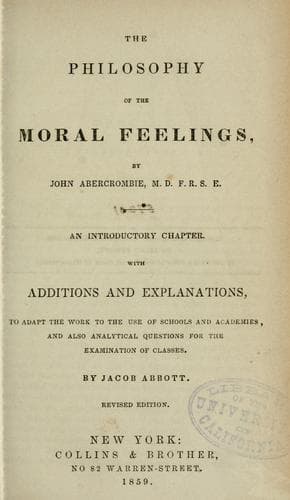
The Philosophy of the Moral FeelingsAbercrombie, John
Religion
The Philosophy of the Moral Feelings
Abercrombie, John
Ethics
As the desires are calculated to bring some gratification to ourselves,
the Affections lead us to our relations to other men, and to a certain
line of conduct which arises out of these relations. They are to be
viewed as original principles of our nature, planted in us for wise
purposes, and the operation of them is to be considered as distinct,
both from that of the moral principle and of reason,--that is, from any
sense of duty or the moral rectitude of the conduct to which they lead,
and from any calculation of its propriety and utility. Thus, when the
mother devotes her attention by day and night to her infant, if from
sickness or helplessness in want of her special care, and perseveres in
doing so, with total disregard to her own ease, health, or comfort, she
is not influenced either by a sense of duty, or by any feeling of the
utility of her conduct: she acts upon an impulse within, which she feels
to be a part of her constitution, and which carries her forward in a
particular course of anxious and protracted exertion by the power of
itself alone. This distinction appears to be of the utmost practical
importance, and we shall have occasion to refer to it more particularly
in the sequel.
An Affection, therefore, maybe considered as an original feeling or
emotion existing in ourselves, which leads us to a particular conduct
towards other men, without reference to any principle except the
intuitive impulse of the emotion itself. The Affections have been
divided into the Benevolent and Malevolent; but these titles appear to
be incorrect, especially the latter,--as the due exercise of the
emotions to which it refers does not properly include what is called
malevolence. They only tend to guard us against certain conduct in other
men; and, when they are allowed to go beyond this, that is, to actual
malevolence or revenge, the application is morbid. It will therefore
accord better with the nature of these emotions, to give them the names
of Uniting, and Defensive Affections;--the former including justice,
benevolence, veracity, friendship, love, gratitude, patriotism, and the
domestic affections;--the latter, jealousy, disapprobation, and anger.
I. JUSTICE.
Public-domain text, read in full here on John Shaqi.
Reviews
Reviews
No reviews yet
Be the first to share your thoughts on this work.
Join the Discussion
Join the discussion
Sign in to leave a comment or review.
Sign InorCreate an account