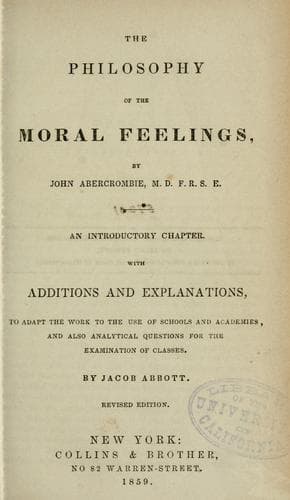
The Philosophy of the Moral FeelingsAbercrombie, John
Religion
The Philosophy of the Moral Feelings
Abercrombie, John
Ethics
There may be some difference of opinion in regard to the propriety of
including justice among the affections; but it seems to be more nearly
allied to them than to any of the other classes of moral emotions which
have been mentioned, and it may, therefore, as a mere matter of
arrangement, be conveniently introduced here. Strictly speaking, it
might perhaps be considered as a combined operation of an affection and
the moral principle; but this is matter of speculation alone. The
important consideration relating to it is,--that, in whatever manner it
arises, the sense of Justice is a primary and essential part of our
moral constitution, conveying the distinct impression of certain conduct
which a man owes to his fellow-men, without regard to any considerations
of a personal nature, and apart from all positive enactments or laws,
either divine or human. The requirements of Justice embrace certain
points in which every man has an absolute right, and in regard to which
it is the absolute duty of every other man not to interfere with him.
These rights have usually been divided into three classes;--what I have
a right to possess, and no man has any right to take from me,--what I
have a right to do, and no man has any title to prevent me from
doing,--what I have a right to expect from other men, and it is their
absolute duty to perform. These principles form the basis of what is
called Natural Jurisprudence, a code of relative duty deriving its
authority from impressions which are found in the moral feelings of all
mankind, without regard to the enactments of any particular civil
society. In the actual arrangements of civil communities, these great
principles of justice are combined with others which are derived merely
from utility or expediency, as calculated to promote the peace or the
advantage of the community. These may differ in different countries, and
they cease to be binding when the enactments on which they rest are
abrogated or changed. But no difference of place can alter, and no laws
can destroy, the essential requirements of justice.
In these observations, it will be remarked, the word Justice is used as
expressing a principle of individual character; and it is in this sense
that it is to be properly classed with the affections. The term is
employed in another sense, namely, that of distributive and corrective
justice, which regulates the claims of individuals in a community,
requires restitution or compensation for any deviation from such claims,
or punishes those who have violated them. It is in the former sense that
justice is properly to be considered as a branch of the philosophy of
the moral feelings; but the same general principles apply to both.
Public-domain text, read in full here on John Shaqi.
Reviews
Reviews
No reviews yet
Be the first to share your thoughts on this work.
Join the Discussion
Join the discussion
Sign in to leave a comment or review.
Sign InorCreate an account