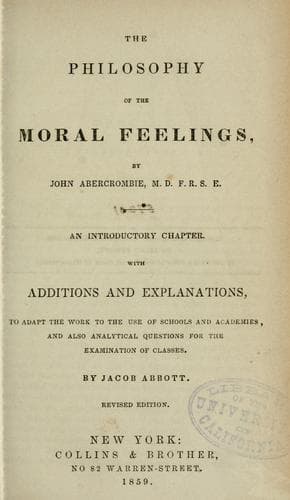
The Philosophy of the Moral FeelingsAbercrombie, John
Religion
The Philosophy of the Moral Feelings
Abercrombie, John
Ethics
(3.) Justice enjoins a regard to the reputation of others. This consists
in avoiding every thing that could be injurious to their good name,
either by direct evil speaking, or such insinuations as might give rise
to suspicion or prejudice against them. It must extend also to the
counteracting of such insinuations, when we hear them made by others,
especially in circumstances in which the individual injured has no
opportunity of defending himself. It includes, farther, that we do not
deny to others, even to rivals, any praise or credit which is justly due
to them. There is, however, one modification, equally consistent with
justice, to which the former of these rules is liable; namely, that, in
certain cases, we may be required to make a statement prejudicial to an
individual, when duty to a third party or to the public makes it
incumbent on us to do so. In such a case, a person guided by the rules
of justice will go no farther than is actually required by the
circumstances; and will at all times beware of propagating a report
injurious to another, though he should know it to be strictly true,
unless he is called upon by special duty to communicate it.
(4.) Justice requires us not only to avoid injuring an individual in the
estimation of other men, but to exercise the same fairness in forming
our own opinion of his character, without being misled or biased by
passion or prejudice. This consists in estimating his conduct and
motives with calmness and impartiality; in regard to particular
instances, making full allowance for the circumstances in which he was
placed, and the feelings by which he was, or might be, at the time,
naturally influenced. When an action admits of being referred to
different motives, justice consists in taking the more favourable view,
if we can do so with strict regard to truth, instead of harshly and
hastily assigning a motive which is unworthy. Such justice in regard to
character and motives we require to exercise with peculiar care, when
the conduct referred to has been in any way opposed to our own
self-love. In these cases we must be especially on our guard against
the influence of the selfish principle, which might lead to partial and
distorted views of actions and motives, less favourable to others, and
more favourable to ourselves, than justice warrants. When viewed in this
manner, we may often perceive, that conduct, which gave rise to emotions
of displeasure as injurious to us, was fully warranted by some conduct
on our own part, or was required by some higher duty which the
individual owed to another.
Public-domain text, read in full here on John Shaqi.
Reviews
Reviews
No reviews yet
Be the first to share your thoughts on this work.
Join the Discussion
Join the discussion
Sign in to leave a comment or review.
Sign InorCreate an account