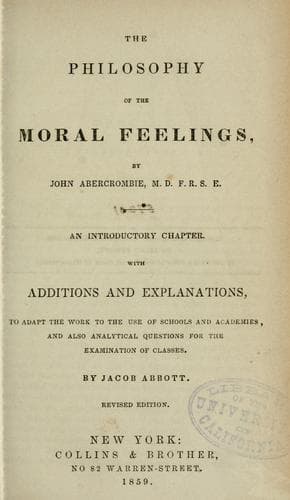
The Philosophy of the Moral FeelingsAbercrombie, John
Religion
The Philosophy of the Moral Feelings
Abercrombie, John
Ethics
The sense of Justice, therefore, consists in a feeling experienced by
every man, of a certain line of conduct which he owes to other men in
given circumstances; and this seems to be referable to the following
heads,--attending to their interest,--not interfering with their freedom
of action,--preserving their reputation,--estimating their character and
motives,--judging of their opinions,--consulting their feelings,--and
preserving or improving their moral condition. As a guide for his
conduct in particular instances, a man has usually a distinct impression
of what he thinks due by other men towards himself; justice requires
that he rigidly extend to others the same feelings and conduct which, in
similar circumstances, he expects from them.
(1.) Justice is due to the persons, property, and interest of others.
This constitutes Integrity or Honesty. It, of course, implies abstaining
from every kind of injury, and preserving a conscientious regard to
their rights. In this last respect, it allows us to exercise a prudent
attention to our own interest, provided the means be fair and
honourable, and that we carefully abstain from injuring others by the
measures we employ for this purpose. The great rule for our guidance, in
all such cases, is found in the immutable principles of moral rectitude;
the test of our conduct in regard to individual instances is, that it be
such as, were our own interest concerned, we should think fair and
honourable in other men.
(2.) Justice requires us not to interfere with the freedom of action of
others. This constitutes personal liberty;--but in all civil communities
the right is liable to certain restrictions;--as when a man uses his
freedom of action to the danger or injury of other men. The principles
of justice may also recognise a man's surrendering, to a certain extent,
his personal liberty, by mutual and voluntary compact, as in the case of
servants, apprentices, soldiers, &c.; but they are opposed to slavery,
in which the individual concerned is not a party to the arrangement.
Public-domain text, read in full here on John Shaqi.
Reviews
Reviews
No reviews yet
Be the first to share your thoughts on this work.
Join the Discussion
Join the discussion
Sign in to leave a comment or review.
Sign InorCreate an account