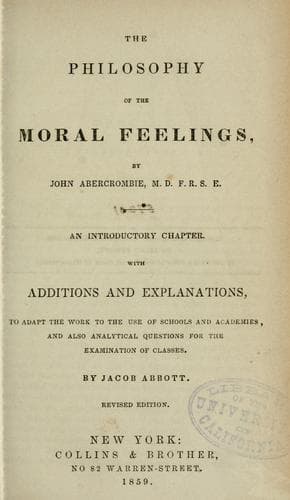
The Philosophy of the Moral FeelingsAbercrombie, John
Religion
The Philosophy of the Moral Feelings
Abercrombie, John
Ethics
Great diversity exists in the condition of different individuals in the
present state,--some being in circumstances of ease, wealth, and
comfort,--others of pain, deprivation, and sorrow. Such diversities we
must consider as an arrangement established by the great Disposer of all
things, and calculated to promote important purposes in his moral
government. Many of these purposes are entirely beyond the reach of our
faculties; but, as holding a prominent place among them, we may safely
reckon the cultivation of our moral feelings, especially the affections
of compassion and benevolence. The due exercise of these is, therefore,
calculated to promote a double object, namely, the alleviation of
distress in others,--and the cultivation in ourselves of a mental
condition peculiarly adapted to a state of moral discipline. By bringing
us into contact with individuals in various forms and degrees of
suffering, they tend continually to remind us, that the present scene is
but the infancy of our existence,--that the beings whom we thus
contemplate are the children of the same Almighty Father with ourselves,
inheriting the same nature, possessed of the same feelings, and soon to
enter upon another state of existence, when all the distinctions which
are to be found in this world shall cease for ever. They tend thus to
withdraw us from the power of self-love, and the deluding influence of
present things; and habitually to raise our views to that future life,
for which the present is intended to prepare us. The due cultivation of
the benevolent affections, therefore, is not properly to be considered
as the object of moral approbation, but rather as a process of moral
culture. They may enable us in some degree to benefit others, but their
chief benefit is to ourselves. By neglecting them, we both incur much
guilt, and deprive ourselves of an important mean of improvement. The
diligent exercise of them, besides being a source of moral advantage, is
accompanied with a degree of mental enjoyment which carries with it its
own reward. Such appears to be the correct view which we ought to take
of the arrangement established by the Creator in this part of our
constitution. It is calculated to correct a misconception of an
important kind, which considers the exercise of the benevolent
affections as possessing a character of merit. To this subject we shall
have occasion to refer more particularly in the sequel.
Public-domain text, read in full here on John Shaqi.
Reviews
Reviews
No reviews yet
Be the first to share your thoughts on this work.
Join the Discussion
Join the discussion
Sign in to leave a comment or review.
Sign InorCreate an account