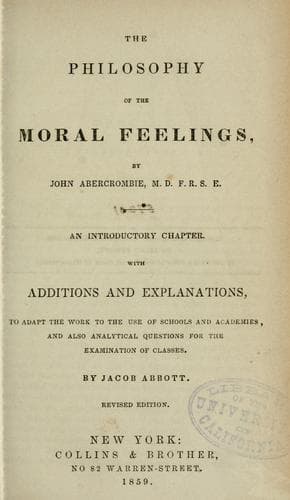
The Philosophy of the Moral FeelingsAbercrombie, John
Religion
The Philosophy of the Moral Feelings
Abercrombie, John
Ethics
I. A primary and essential element, in the due regulation of the will,
is a correct knowledge of the truths and motives which tend to influence
its determinations. The highest class of these comprehends the truths of
religious belief,--a series of moral causes, the tendencies of which are
of the most important kind, and calculated to exert a uniform power over
every man who surrenders himself to their guidance. For this purpose, a
correct knowledge of them is required, and, to all who have this
knowledge within their reach, the careful acquisition involves a point
of the deepest moral responsibility. The sacred writers speak in the
strongest terms of the guilt attached to voluntary ignorance: and this
must be obvious to every one who considers the clearness with which the
highest truths are disclosed, and the incontrovertible evidence by which
they are supported. This applies equally to the principles both of
natural and of revealed religion. The important truths of natural
religion are partly matters of the most simple induction from the
phenomena of nature which are continually before us; and partly
impressed upon our own moral constitution in the clearest and most
forcible manner. From the planet revolving in its appointed orbit, to
the economy of the insect on which we tread, all nature demonstrates,
with a power which we cannot put away from us, the great
incomprehensible One, a being of boundless perfections and infinite
wisdom. In regard to his moral attributes, also, he has not left himself
without a witness; for a sense of these he has impressed upon us in the
clearest manner in that wondrous part of our constitution,--the moral
principle or conscience. From these two sources may be derived a
knowledge of the character of the Deity, and of our relation to him as
moral beings;--and the man is left entirely without excuse who fails to
direct to them his most earnest attention, and to make the impressions
derived from them the habitual rule of his volitions, and the guide of
his whole character. "He hath the rule of right within," says Butler,
"all that is wanting is,--that he honestly attend to it."
Public-domain text, read in full here on John Shaqi.
Reviews
Reviews
No reviews yet
Be the first to share your thoughts on this work.
Elsewhere in the archive
Join the Discussion
Join the discussion
Sign in to leave a comment or review.
Sign InorCreate an account