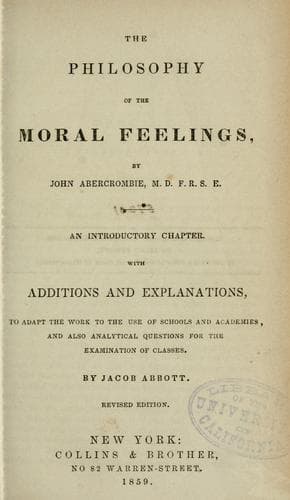
The Philosophy of the Moral FeelingsAbercrombie, John
Religion
The Philosophy of the Moral Feelings
Abercrombie, John
Ethics
Similar observations apply with equal or greater force to the truths of
revealed religion. These are supported by a weight of miraculous
evidence, and are transmitted to us by a chain of testimony, carrying
absolute conviction to the mind of every candid inquirer. They are
farther confirmed by a probability, and a force of internal evidence,
which fix themselves upon the moral feelings of every sound
understanding with a power which is irresistible. The whole is addressed
to us as rational beings; it is pressed upon our attention as creatures
destined for another state of existence; and the duty is imposed upon
every individual seriously to examine and to consider. Every man is in
the highest degree responsible for the care with which he has informed
himself of these evidences, and for the attention with which he has
given to every part of them its due weight in the solemn inquiry. He is
farther responsible for the influence of previously formed prejudice, or
that vitiated state of his moral feelings, which prevents him from
approaching the subject with the simplicity of a mind which is seriously
desirous of the truth. From the want of these essential elements of
character, it may very often happen, that a man may fancy he has formed
his opinions after much examination, while the result of his prejudiced
or frivolous inquiry has been only to fix him in delusion and falsehood.
Among the singular sophistries, indeed, by which some men shut their
minds against inquiries of the highest import, is a kind of impression,
not perhaps distinctly avowed in words, but clearly recognised in
practice, that these subjects of belief are in great measure matters of
opinion,--instead of being felt to rest upon the basis of immutable and
eternal truth. Can any thing be more striking than the manner in which a
late distinguished poet expresses himself on the subject of a future
life,--as if this truth were a mere opinion which could be taken up or
laid down at pleasure, to suit the taste of the individual
inquirer;--"Of the two, I should think the long sleep better than the
agonized vigil. But men, miserable as they are, cling so to any thing
like life, that they probably would prefer damnation to quiet. Besides,
they think themselves so important in the creation, that nothing less
can satisfy then pride,--the insects!"[1] Such is the frivolous
sophistry by which one, who holds a high rank in the literature of his
country, could put away from him the most momentous inquiry that can
engage the attention of a rational being.
[Footnote 1: Byron's Letters, Moore's Life, Vol. II, p. 581.]
Public-domain text, read in full here on John Shaqi.
Reviews
Reviews
No reviews yet
Be the first to share your thoughts on this work.
Elsewhere in the archive
Join the Discussion
Join the discussion
Sign in to leave a comment or review.
Sign InorCreate an account