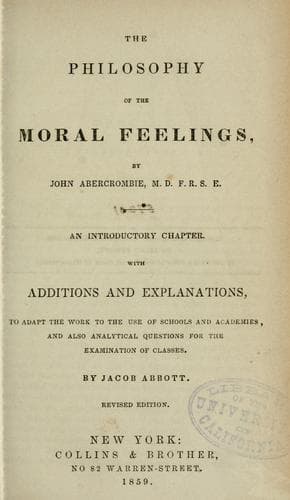
The Philosophy of the Moral FeelingsAbercrombie, John
Religion
The Philosophy of the Moral Feelings
Abercrombie, John
Ethics
II. Next to the acquisition of knowledge, and the formation of opinions,
calculated to act upon us as moral beings, is the important rule of
habitually attending to them, so as to bring their influence to bear
upon our volitions. He, who honestly attends to what is passing within,
will perceive that this is a voluntary exercise of his thinking and
reasoning faculties. When a particular desire is present to his mind, he
has the power to act upon the first impulse, or upon a very partial and
limited, perhaps a distorted, view of the considerations and motives by
which he ought to be influenced;--and he has the power to suspend
acting, and direct his attention deliberately and fully to the facts and
principles which are calculated to guide his determination. This is the
first great step in that remarkable chain of sequences which belong to
the regulation of the will. It is what every one is conscious of; and,
putting aside all those metaphysical subtleties in which the subject has
been involved, this constitutes man a free and responsible agent. In
this important process, the first mental state is a certain movement of
one of the desires or one of the affections;--we may use the term
Inclination as including both. The second is a reference of the
inclination to the moral causes or motives which more peculiarly apply
to it,--especially the indications of conscience, and the principles of
moral rectitude.--If these be found to harmonize with the inclination,
volition and action follow, with the full concurrence of every moral
feeling. If the inclination be condemned by these, it is, in a
well-regulated mind, instantly dismissed, and the healthy condition of
the moral being is preserved. But this voluntary and most important
mental process may be neglected;--the inclination may be suffered to
engross the mind and occupy fully the attention:--the power may not be
exercised of directing it to moral causes and motives, and of comparing
with them the inclination which is present. The consequence may be, that
the man runs heedlessly into volition and action, from which the due
exercise of this process of the mind might have preserved him.
Public-domain text, read in full here on John Shaqi.
Reviews
Reviews
No reviews yet
Be the first to share your thoughts on this work.
Elsewhere in the archive
Join the Discussion
Join the discussion
Sign in to leave a comment or review.
Sign InorCreate an account