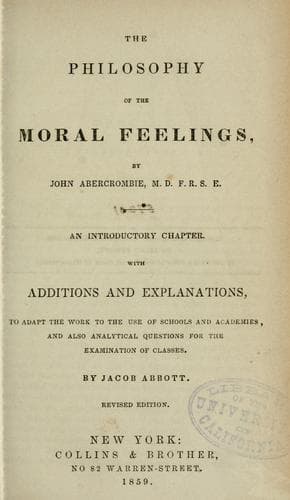
The Philosophy of the Moral FeelingsAbercrombie, John
Religion
The Philosophy of the Moral Feelings
Abercrombie, John
Ethics
But a third condition may take place which presents a subject of the
highest interest. The moral causes may be so far attended to, as to
prevent the inclination from being followed by action; while the
inclination is still cherished, and the mind is allowed to dwell, with a
certain feeling of regret, on the object which it had been obliged to
deny itself. Though the actual deed be thus prevented, the harmony of
the moral feelings is destroyed;--and that mental condition is lost
which is strictly to be called purity of heart. For this consists in the
desires and affections, as well as the conduct, being in strict
subjection to the indications of conscience and the principles of moral
rectitude. The inclination, thus cherished, gradually acquires greater
ascendency over the moral feelings;--at each succeeding contest, it more
and more occupies the mind; the attention is less and less directed to
the moral truths and motives which are opposed to it; the inclination at
length acquires the predominance, and is followed by volition. This is
what we mean by a man being carried away by passion, in opposition to
his moral conviction; for passion consists in a desire or an affection
which has been allowed to engross the mind, until it gradually
overpowers the moral causes which are calculated to counteract its
influence. Now in the whole of this course each single movement of the
mind is felt to be entirely voluntary. From that step, which constitutes
the first departure from moral purity, the process consists in a desire
being cherished which the moral feelings condemn; while, at each
succeeding step, the influence of these feelings is gradually weakened,
and finally destroyed. Such is the economy of the human heart, and such
the chain of sequences to be traced in the moral history of every man,
who, with a conviction upon his mind of what is right, has followed the
downward course which gradually led him astray from virtue. When we
trace such a process backwards in a philosophical point of view, the
question still recurs,--what was the first step, or that by which the
mind was led into the course which thus terminated in favour of vice. In
the wonderful chain of sequences, which has been established in the
mental constitution, it would appear that a very slight movement only is
required for deranging the delicate harmony which ought to exist among
the moral feelings; but this each individual feels to be entirely
voluntary. It may consist in a desire being cherished which the moral
feelings disapprove;--and, though the effect at first may be small, a
morbid influence has arisen, which gains strength by continuance, and at
last acquires the power of a moral habit. The more the desire is
cherished, the less is the attention directed to the considerations or
moral causes by which it might be counteracted. In this manner,
according to the mental economy, these causes gradually lose their power
Public-domain text, read in full here on John Shaqi.
Reviews
Reviews
No reviews yet
Be the first to share your thoughts on this work.
Elsewhere in the archive
Join the Discussion
Join the discussion
Sign in to leave a comment or review.
Sign InorCreate an account