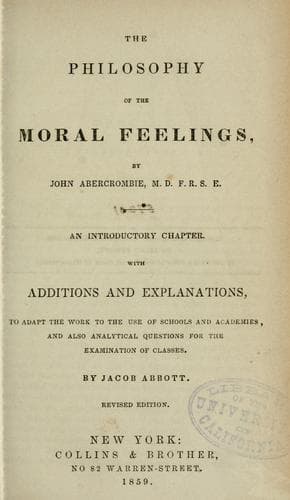
The Philosophy of the Moral FeelingsAbercrombie, John
Religion
The Philosophy of the Moral Feelings
Abercrombie, John
Ethics
apostle Paul, in calling upon the people of Lystra to worship the true
God, who made heaven and earth, adds, as a source of knowledge from
which they ought to learn his character;--"he left not himself without a
witness, in that he did good, and gave us rain from heaven and fruitful
seasons, filling our hearts with food and gladness."
A being, thus endowed with infinite power, wisdom, and goodness, we
cannot conceive to exist without moral feelings; and, by a process
equally obvious, we arrive at a distinct knowledge of these, when, from
the moral perceptions of our own minds, we infer the moral attributes of
him who thus formed us. We have certain impressions of justice,
veracity, compassion, and moral purity, in regard to our own
conduct,--we have a distinct approbation of these qualities in
others,--and we attach a feeling of disapprobation to the infringement
of them. By a simple step of reasoning, which conveys an impression of
absolute conviction, we conclude, that he, who formed us with these
feelings, possesses, in his own character, corresponding moral
attributes, which, while they resemble in kind, must infinitely exceed
in degree, those qualities in the wisest and the best of men. In our
actual observation of mankind, we perceive these attributes impaired in
their exercise by human weakness, distorted by human passion,--and
impeded in their operation by personal wants, personal feelings, and
selfish interests. But, apart from such deteriorating causes, we have a
certain abstract idea of the full and perfect exercise of those
qualities; and it is in this pure and perfect form that we ascribe them
to the Almighty. In him, they can be impeded by no weakness,--distorted
by no passion, and impaired in their operation by no personal interest.
We therefore conclude him to be perfect in the exercise of all these
moral attributes, and to take the most rigid estimate of any
infringement of them by man:--this is what we call the holiness of God.
Even the man, who has himself departed from moral rectitude, still feels
a power within, which points with irresistible force to what is purity,
and fixes upon him a conviction that God is pure.
Public-domain text, read in full here on John Shaqi.
Reviews
Reviews
No reviews yet
Be the first to share your thoughts on this work.
Elsewhere in the archive
Join the Discussion
Join the discussion
Sign in to leave a comment or review.
Sign InorCreate an account