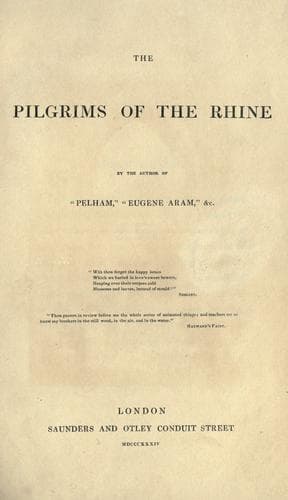
The Pilgrims of the RhineLytton, Edward Bulwer Lytton, Baron
Science
The Pilgrims of the Rhine
Lytton, Edward Bulwer Lytton, Baron
Fairies -- Fiction; Fantasy fiction; Rhine River Valley -- Fiction
You know, at least I do, dearest Gertrude, that there is such a thing as
love at the first meeting,--a secret, an unaccountable affinity between
persons (strangers before) which draws them irresistibly together,--as
if there were truth in Plato’s beautiful fantasy, that our souls were
a portion of the stars, and that spirits, thus attracted to each other,
have drawn their original light from the same orb, and yearn for a
renewal of their former union. Yet without recurring to such fanciful
solutions of a daily mystery, it was but natural that one in the forlorn
and desolate condition of Eugene St. Amand should have felt a certain
tenderness for a person who had so generously suffered for his sake.
The darkness to which he was condemned did not shut from his mind’s eye
the haunting images of Ideal beauty; rather, on the contrary, in his
perpetual and unoccupied solitude, he fed the reveries of an imagination
naturally warm, and a heart eager for sympathy and commune.
He had said rightly that his only test of beauty was in the melody of
voice; and never had a softer or more thrilling tone than that of the
young maiden touched upon his ear. Her exclamation, so beautifully
denying self, so devoted in its charity, “Thank God, _you_ are saved!”
uttered too in the moment of her own suffering, rang constantly upon his
soul, and he yielded, without precisely defining their nature, to vague
and delicious sentiments, that his youth had never awakened to till
then. And Lucille--the very accident that had happened to her on his
behalf only deepened the interest she had already conceived for one who,
in the first flush of youth, was thus cut off from the glad objects of
life, and left to a night of years desolate and alone. There is, to your
beautiful and kindly sex, a natural inclination to _protect_. This makes
them the angels of sickness, the comforters of age, the fosterers
of childhood; and this feeling, in Lucille peculiarly developed, had
already inexpressibly linked her compassionate nature to the lot of the
unfortunate traveller. With ardent affections, and with thoughts beyond
her station and her years, she was not without that modest vanity
which made her painfully susceptible to her own deficiencies in beauty.
Instinctively conscious of how deeply she herself could love, she
believed it impossible that she could ever be so loved in return. The
stranger, so superior in her eyes to all she had yet seen, was the first
who had ever addressed her in that voice which by tones, not words,
speaks that admiration most dear to a woman’s heart. To _him_ she was
beautiful, and her lovely mind spoke out, undimmed by the imperfections
of her face. Not, indeed, that Lucille was wholly without personal
attraction; her light step and graceful form were elastic with the
freshness of youth, and her mouth and smile had so gentle and tender
an expression, that there were moments when it would not have been
Public-domain text, read in full here on John Shaqi.
Reviews
Reviews
No reviews yet
Be the first to share your thoughts on this work.
Join the Discussion
Join the discussion
Sign in to leave a comment or review.
Sign InorCreate an account