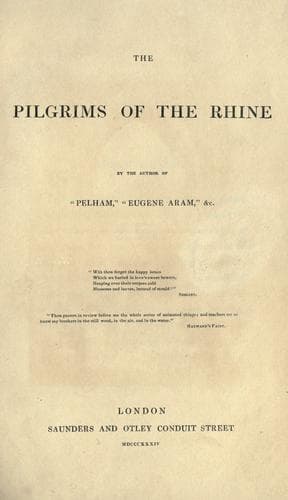
The Pilgrims of the RhineLytton, Edward Bulwer Lytton, Baron
Science
The Pilgrims of the Rhine
Lytton, Edward Bulwer Lytton, Baron
Fairies -- Fiction; Fantasy fiction; Rhine River Valley -- Fiction
the blind only who would have mistaken her to be beautiful. Her early
childhood had indeed given the promise of attractions, which the
smallpox, that then fearful malady, had inexorably marred. It had not
only seared the smooth skin and brilliant hues, but utterly changed even
the character of the features. It so happened that Lucille’s family were
celebrated for beauty, and vain of that celebrity; and so bitterly had
her parents deplored the effects of the cruel malady, that poor Lucille
had been early taught to consider them far more grievous than they
really were, and to exaggerate the advantages of that beauty, the loss
of which was considered by her parents so heavy a misfortune. Lucille,
too, had a cousin named Julie, who was the wonder of all Malines for
her personal perfections; and as the cousins were much together, the
contrast was too striking not to occasion frequent mortification to
Lucille. But every misfortune has something of a counterpoise; and the
consciousness of personal inferiority had meekened, without souring, her
temper, had given gentleness to a spirit that otherwise might have been
too high, and humility to a mind that was naturally strong, impassioned,
and energetic.
And yet Lucille had long conquered the one disadvantage she most dreaded
in the want of beauty. Lucille was never known but to be loved.
Wherever came her presence, her bright and soft mind diffused a certain
inexpressible charm; and where she was not, a something was absent from
the scene which not even Julie’s beauty could replace.
“I propose,” said St. Amand to Madame le Tisseur, Lucille’s mother,
as he sat in her little salon,--for he had already contracted that
acquaintance with the family which permitted him to be led to their
house, to return the visits Madame le Tisseur had made him, and his dog,
once more returned a penitent to his master, always conducted his
steps to the humble abode, and stopped instinctively at the door,--“I
propose,” said St. Amand, after a pause, and with some embarrassment,
“to stay a little while longer at Malines; the air agrees with me, and
I like the quiet of the place; but you are aware, madam, that at a hotel
among strangers, I feel my situation somewhat cheerless. I have been
thinking”--St. Amand paused again--“I have been thinking that if I could
persuade some agreeable family to receive me as a lodger, I would fix
myself here for some weeks. I am easily pleased.”
“Doubtless there are many in Malines who would be too happy to receive
such a lodger.”
“Will you receive me?” asked St. Amand, abruptly. “It was of _your_
family I thought.”
“Of us? Monsieur is too flattering. But we have scarcely a room good
enough for you.”
“What difference between one room and another can there be to me? That
is the best apartment to my choice in which the human voice sounds most
kindly.”
Public-domain text, read in full here on John Shaqi.
Reviews
Reviews
No reviews yet
Be the first to share your thoughts on this work.
Join the Discussion
Join the discussion
Sign in to leave a comment or review.
Sign InorCreate an account