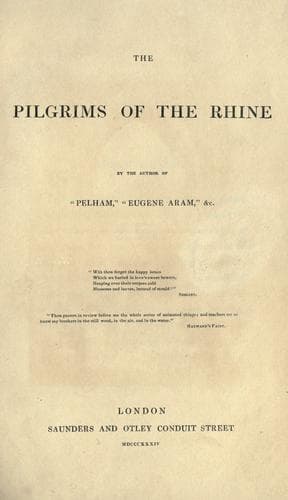
The Pilgrims of the RhineLytton, Edward Bulwer Lytton, Baron
Science
The Pilgrims of the Rhine
Lytton, Edward Bulwer Lytton, Baron
Fairies -- Fiction; Fantasy fiction; Rhine River Valley -- Fiction
St. Amand alone was not to be won to her departure; he chafed at the
notion of a dowry; he was not appeased even by Lucille’s representation
that it was only to gratify and not to impoverish her parents. “And
_thou_, too, canst leave me!” he said, in that plaintive voice which had
made his first charm to Lucille’s heart. “It is a double blindness!”
“But for a few days; a fortnight at most, dearest Eugene.”
“A fortnight! you do not reckon time as the blind do,” said St. Amand,
bitterly.
“But listen, listen, dear Eugene,” said Lucille, weeping.
The sound of her sobs restored him to a sense of his ingratitude. Alas,
he knew not how much he had to be grateful for! He held out his arms
to her. “Forgive me,” said he. “Those who can see Nature know not how
terrible it is to be alone.”
“But my mother will not leave you.”
“She is not you!”
“And Julie,” said Lucille, hesitatingly.
“What is Julie to me?”
“Ah, you are the only one, save my parents, who could think of me in her
presence.”
“And why, Lucille?”
“Why! She is more beautiful than a dream.”
“Say not so. Would I could see, that I might prove to the world how much
more beautiful thou art! There is no music in her voice.”
The evening before Lucille departed she sat up late with St. Amand and
her mother. They conversed on the future; they made plans; in the wide
sterility of the world they laid out the garden of household love, and
filled it with flowers, forgetful of the wind that scatters and the
frost that kills. And when, leaning on Lucille’s arm, St. Amand sought
his chamber, and they parted at his door, which closed upon her, she
fell down on her knees at the threshold, and poured out the fulness of
her heart in a prayer for his safety and the fulfilment of her timid
hope.
At daybreak she was consigned to the conveyance that performed the short
journey from Malines to Bruxelles. When she entered the town, instead
of seeking her aunt, she rested at an _auberge_ in the suburbs, and
confiding her little basket of lace to the care of its hostess, she
set out alone, and on foot, upon the errand of her heart’s lovely
superstition. And erring though it was, her faith redeemed its weakness,
her affection made it even sacred; and well may we believe that the Eye
which reads all secrets scarce looked reprovingly on that fanaticism
whose only infirmity was love.
Public-domain text, read in full here on John Shaqi.
Reviews
Reviews
No reviews yet
Be the first to share your thoughts on this work.
Join the Discussion
Join the discussion
Sign in to leave a comment or review.
Sign InorCreate an account